In the AI era, how should we use notes "correctly"? Today I want to share a system I’m practicing.
Let me explain something first: This is not a "collection of skills" that can be completed with one or two Claude skills, but a system that will grow with you. The more eager you are to acquire new knowledge, the more valuable it will be; if you just want to take away a ready-made skill, this article will most likely not give you what you want.
In the various note-taking systems in the past, our biggest pain point was: we took a lot of notes but hardly used them. The accumulation of more and more notes just gives myself the comfort of "I am learning". We call this state "hamster syndrome". The essential reason is that we have never figured out what the purpose of this note-taking system is. We just instinctively note more to appease anxiety.
The most essential thing is that our original intention of taking notes is to make our lives better and to grow ourselves. If you don’t want to grow or make progress, who would take notes? But the reason for taking notes is to assist us in decision-making.
- Knowledge Notes: To be able to give the “right answer” in a test, interview or job.
- Meeting Notes: To decide what to do next.
- Inspiration notes: entry points for deciding topics and questions for your next project.
- Wealth Notes: To decide how to spend your money.
So essentially, if we don’t use notes for anything, then these things are dead data, meaningless and can only satisfy self-comfort.
Life is composed of countless choices, and not making a choice is also a choice in itself - it is a choice to escape. The quality of decision-making determines the quality of life to a large extent. Why should the note-taking system focus on "decision-making"? Because once you focus on decision-making, you will naturally have an additional screening mechanism: when I encounter a piece of new knowledge or news, I will ask myself: Is this related to the decision I am making at the moment? Is it related to the decisions I may face in the future? If it's irrelevant, then I can confidently exclude it from the system.
After long-term training, this will help us slowly regain our attention. When we see a piece of news, we no longer instinctively click on it, but stop for a moment and ask ourselves: Does this have anything to do with the decision I am making?
For example, if you are considering changing jobs recently, then the reports about layoffs in a certain industry are highly relevant and worth reading carefully; but on the same day, news about a celebrity's marriage comes across, and you will know at a glance - it has nothing to do with me, and then it will naturally disappear.
After you slowly develop this habit, you will find that it is not that you are rejecting information, but that most information begins to "filter itself" automatically.
Principle: The skeleton of decision-making
So how to improve the quality of decision-making? Therefore, in this system, I put "principles" at the core of the decision-making system.
The so-called principles are reusable judgment rules that we extract from knowledge and past experience. Setting principles that are clear enough and specific enough can help us block emotional interference to a large extent, so that we will not be led astray by impulse at critical moments.
There are roughly two types of sources of principles:
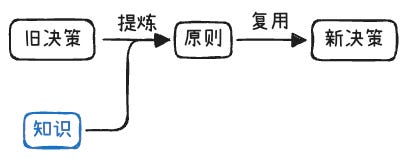
One type comes from external knowledge. Those books, articles, interviews and cases are actually principles abstracted by others after reviewing their own experiences and decisions. You can use it directly, which is equivalent to "borrowing" other people's trial and error results.
Another type comes from one’s own experience review. By constantly reviewing the choices we have made and the emotions we have experienced, we can refine subtle rules that only apply to ourselves, such as "I don't make long-term decisions when I am depressed." This type of principle is often better suited to special situations that will only happen to you.
Values: The underlying operating system
Of course, conflicts between principles are inevitable. For example, "pursuing ultimate efficiency" and "spending more time with family" are opposites in many specific scenarios. To resolve this conflict, a lower-level set of values must be used to make decisions. If your values prioritize long-term health and relationships over short-term results, it will be easier to come up with your own answers when faced with trade-offs.
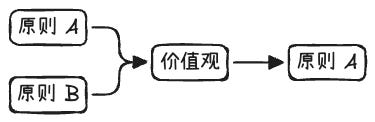
Values are not as easy to change compared to principles, and there are not so many in number compared to principles, but this is our underlying operating system. If principles are compared to various apps on a computer, values are like different operating systems. When two different APPs appear at the same time, the operating system can decide which APP can run on this operating system.
Knowledge: Reusable trial and error of others
As mentioned earlier, knowledge is also an important source of principles. In other words, when you read books, read articles, and listen to other people's reviews, you can actually directly transform other people's experiences and lessons into principles in your own system.
This is a very happy thing: you don’t have to hit all the walls yourself to find an effective path; you can upgrade and iterate your decision-making system by inputting high-quality knowledge.
At the same time, knowledge itself will directly improve the quality of decision-making. New theories, methods and frameworks will give you more dimensions to refer to when facing problems, instead of just relying on your current intuition. Eventually, this absorbed and digested knowledge will be precipitated in the form of "principles", firmly supporting every choice you make in the future.
Note-taking system
Having laid so much groundwork, we can finally talk about the note-taking system itself in detail.
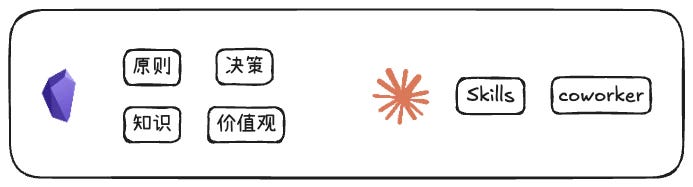
Let me start with a premise: this system is not bound to any specific software, you can use whatever is convenient for you. My own combination is Obsidian + Claude. The reason for choosing Obsidian is simple: all data are local Markdown files, and AI like Claude Cowork can read and process these contents very easily without having to fiddle with various APIs or MCP configurations.
Here, I will not give you a ready-made Skill that can be "applied immediately". This is not meant to make you want to be appetizing, but because: what suits me may not suit you. The most important feature of this system is that it grows with you - as you grow, your focus and decision-making methods change, this system should also be constantly adjusted and reconstructed by you, and gradually become a set that is only suitable for you, rather than copying other people's templates.
In Obsidian, we only need to set up a very simple framework first: create four folders - Decision, Principle, Value and Knowledge.
Special attention should be paid to the three folders Decision, Principle and Value. You can leave it to Claude Cowork to help you generate and maintain them as much as possible; but the Knowledge folder must be managed by you personally. The reason is also very straightforward: if you don’t sort out and digest this knowledge yourself and just let AI write it for you, then these things will never “grow” into you.
How to implement it specifically? We can start with a "decision that has already happened and made you regretful". Open Claude and tell it the ins and outs of this decision, your thoughts and feelings, and the knowledge you had at the time in as much detail as possible. Then let Claude help you sort out a "decision review process" and make it into a Skill that serves as a unified template for all future decision reviews.
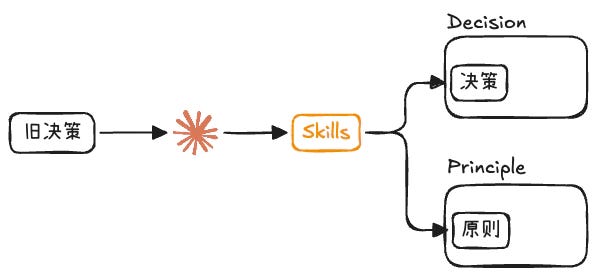
The ideal result is: every review will automatically produce two types of content -
A specific decision review record, stored in the Decision folder;
One or several principles extracted from this experience, stored in the Principle folder.
If during this review, you find that your original values have been corrected or updated, you can also ask Claude to generate a new value description and store it in the Value folder. As for the Skill itself, there is no need to pursue perfection from the beginning. You can rewrite and upgrade it at any time based on your subsequent use experience. At this point, a "Decision Review Skill" is completed - its output is: a decision review document + several new principles.
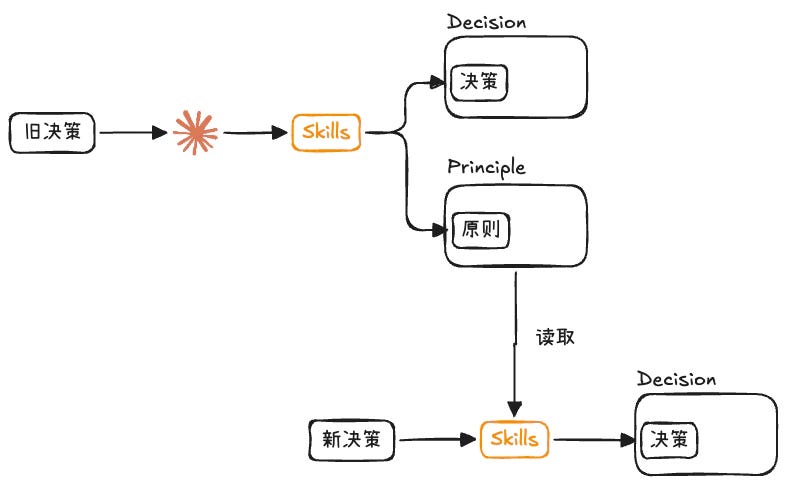
Next, find another decision-making problem you are struggling with now and continue chatting with Claude. The goal of this step is to solidify your current decision-making process into a reusable Skill. The way of chatting is the same as before, just relax and express yourself in the way you usually think. The only point that needs additional emphasis is: you must clearly tell Claude that when using this Skill in the future, ask him to actively refer to the contents of the three folders Decision, Principle and Value to see if there are any experiences and constraints that can be reused. This "Decision Process Skill" will only generate one file - a record of pending or ongoing decisions, saved in the Decision folder.
I hope to talk about this aspect of knowledge separately.
Because of the three folders mentioned earlier (Decision/Principle/Value), most of the content can be handed over to AI to assist in the generation. You yourself play more of a role of "reviewing and fine-tuning the results." But the Knowledge folder is completely different - this must be your home field, and you need to have sufficient understanding and control of every piece of content in it.
Because of this, I would strongly recommend that you give up the idea of "let AI automatically generate knowledge notes for me". In order to do this, I now use Excalidraw to take intellectual notes. On the one hand, the form of drawing can help me disassemble and reorganize abstract concepts and understand them more deeply; on the other hand, the limitations of hand drawing almost naturally eliminate the lazy impulse of "throwing it to AI to generate notes with one click".
The role of knowledge in this system is a source of continuous "feeding" and "upgrading" of the decision-making system. Whenever new knowledge enters your world, you can ask yourself two questions:
How does this relate to the decisions I am making or will make in the future?
Will it improve my existing decision-making processes, principles, or value statements?
For example, you have finished reading the book "The Art of Decision-Making", took more in-depth notes, and truly understood the framework and methods in the book. At this time, you can throw these notes to Claude and let him review it for you: can these contents be used to upgrade the "decision-making process skill" we generated earlier and optimize it into a more systematic decision-making framework in the book.
For another example, if you have carefully studied Ray Dalio’s all-weather strategy and figured out the logic and assumptions inside it, then the next step is to look back and check: In my existing investment decisions, what areas can I refer to and adjust? Is it to modify the principle? Add a new principle? Or add a special review template for certain types of decisions?
This is why I am always unwilling to directly give you my own skills to apply. Maybe in some fields, my knowledge is a bit ahead of yours, so if you copy my skills, there is a high probability that you will not understand them well and use them smoothly. Or maybe in some fields, you are far better than me, and then my set of things will be like student homework to you, which is rough and redundant. So I hope this system can grow with you. It may not be perfect at the beginning, but you can improve this system through your own cognitive improvement.
Grow together
This method is not mysterious at all, and the threshold is not high. Anyone can use it to build it and slowly evolve with it. I prefer to think of it as a "life operating system".
I have always believed that the quality of decision-making determines the quality of life - that is what people often say "choice is greater than effort". This is not to deny the effort itself, but to remind us: more importantly, use our efforts in the right direction.
If this system can help you rediscover the meaning of "continuous progress" in this era, be less impetuous, more patient, and focus back on long-term growth and slow but certain progress, then its existence is already worthwhile.