In writing the previous article, I found that many identities are stigmatized, such as students, nurses, flight attendants, models, etc. At the same time, the work uniforms of these identities have also turned into sexy clothing. I wanted to try to explore the process behind this, but because these identities were so old, I couldn't verify the entire change process. But recently I discovered a new profession that has emerged in recent years. After it became popular on social media, it quickly appeared on pornographic websites, and separate professional clothing was already sold on a certain fish. This gave me a good opportunity and opportunity to explore the process behind it.
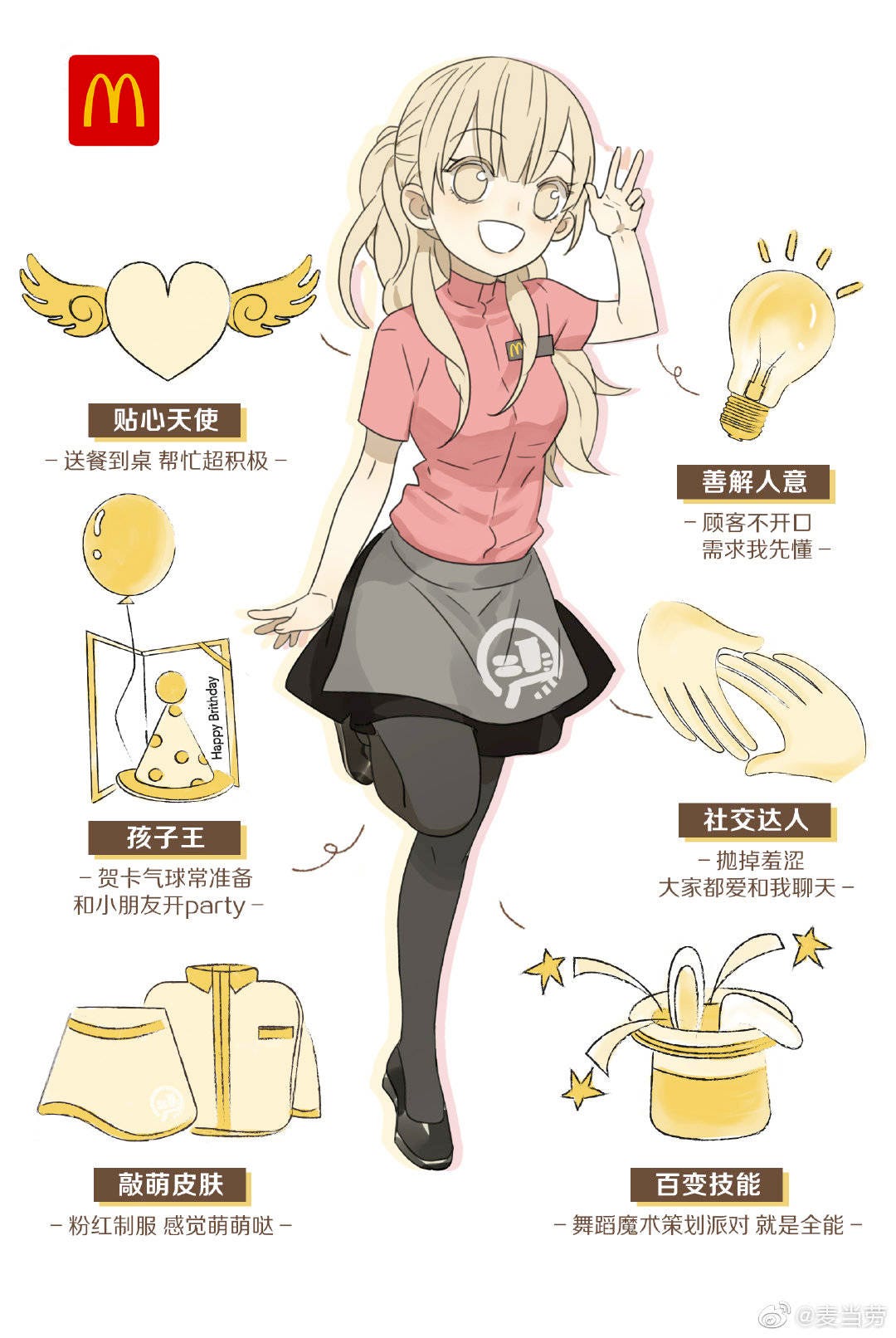
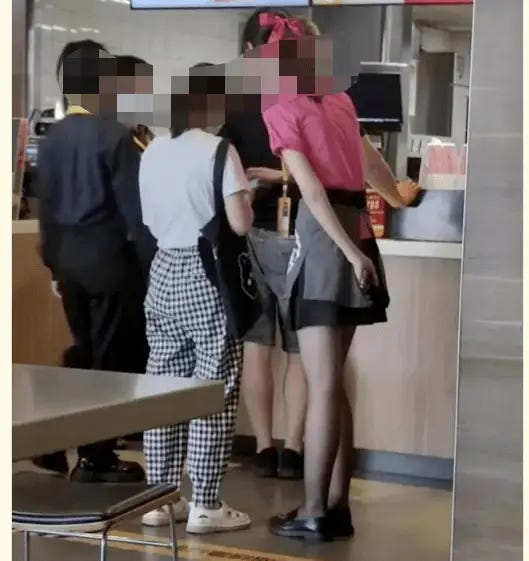
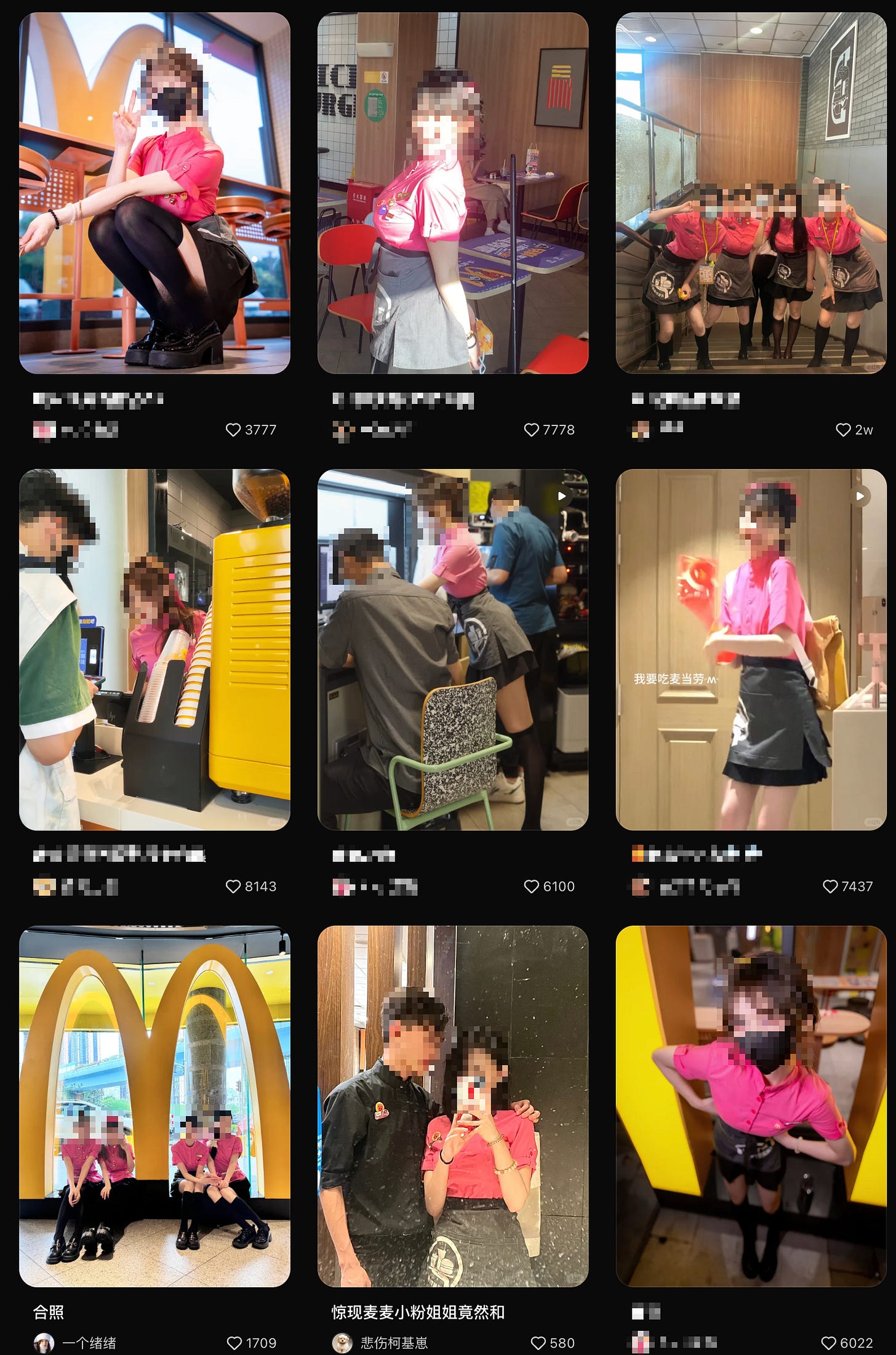
McDonald's launched a new position around 2013 - McDonald's Brand Ambassador (called McDonald's fan on the Internet). What makes this position different from common McDonald's positions is that they basically don't need to prepare food in the backstage or take orders at the front desk. Most of the time, they serve customers in the lobby. McDonald's official definition of brand ambassador is: considerate, caring angel, social master, king of kids, versatile skills, and super cute skin. Different from the previous grey and black work uniforms, this time the female uniform is pink short-sleeved, black skirt, black silk and small leather shoes. This position did not attract much attention at first, but it eventually became popular around 2022 after many girls working in this profession posted photos of their work on social media. After becoming popular, this uniform quickly appeared on porn websites as a sexy uniform. This incident gave me a very good opportunity to observe the development process behind this and explore the reasons for this change.
Identity
One of the reasons why the identity of McDonald's brand ambassador has been sexualized may be because of the power imbalance. In McDonald's official definition of brand ambassador, it is found that the definition of this profession is more of a service-oriented industry, and it is a service-oriented industry that has high contact with customers, so the power between the object being served and the person providing the service is not equal. The paper Power, Objectification, and Recognition of Sexualized Women and Men suggests that power, rather than gender per se, may play a central role in sexual objectification. At the same time, The Relationship Between Social Power and Sexual Objectification: Behavioral and ERP Data This paper basically transplants the experiment in the previous paper, showing that this phenomenon is also tried in China. In the same way, it is not difficult to explain why the identities that appear highly on pornographic websites are almost always those in a low-power status (students, teachers, colleagues, spoiled wives, stewardesses, models, nurses).
Uniform
Next is an analysis of why the uniform itself is sexualized. Constructing one's identity is not an abstract metaphysical act, it is more about appearance and personality. And dressing up can be an act of presenting oneself to others, not only for appreciation and admiration but also for objectification to construct a social identity. So when the identity itself is sexualized, the uniforms associated with the identity naturally become sexualized as well.
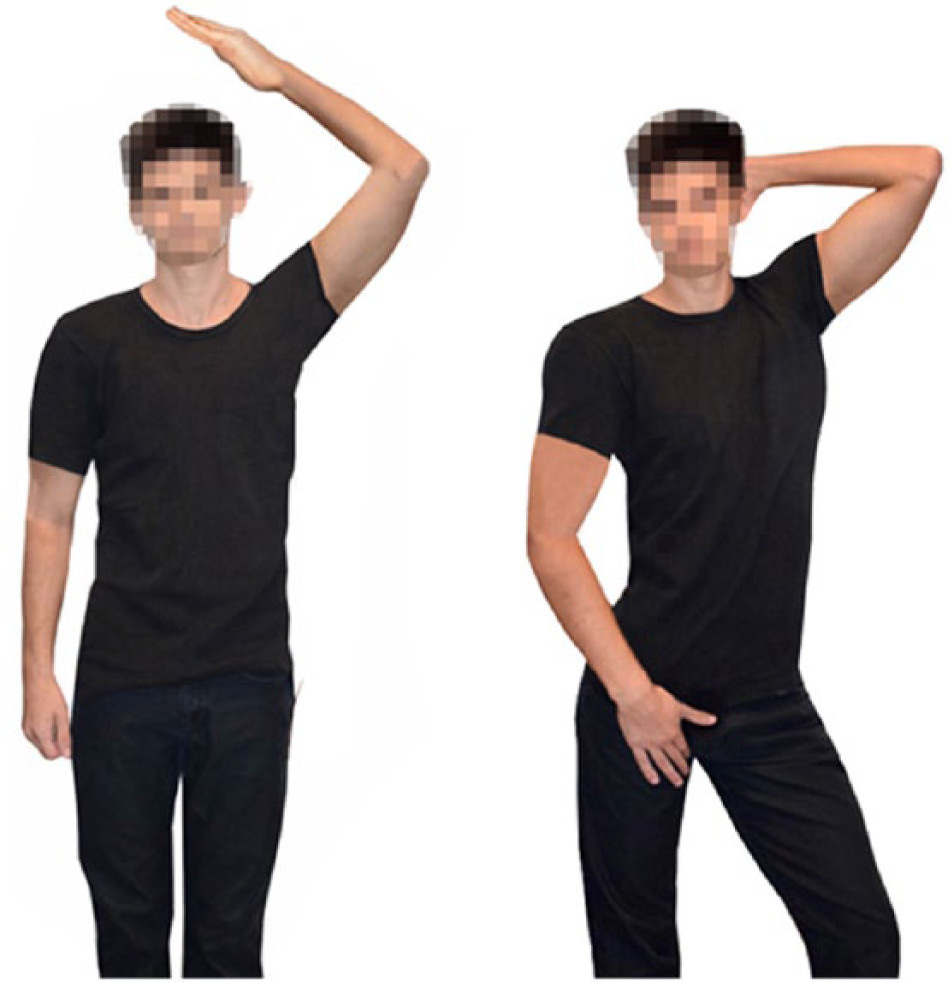
So the fact that this identity has been sexualized is a problem with the design of the uniform itself? My answer is that it has a part to do with it, but it is not the main reason. At the beginning, my research direction also started from the design of this suit. I instinctively thought that it was because the design of this uniform was so imaginative that it eventually led to sexualization. But more nudity than the same male uniform is not the root cause of objectification. In the paper Revealing Clothing Does Not Make the Object: ERP Evidences That Cognitive Objectification is Driven by Posture Suggestiveness, Not by Revealing Clothing, three experiments were conducted. The results of the experiments showed that a high skin-to-clothing ratio (the ratio of bare skin to clothes) did not significantly lead to cognitive objectification. When comparing the skin-to-clothing ratio and posture, the author came to the idea that posture is the key factor that triggers objectification. In experiments with asymmetrical postures, sexually suggestive postures more clearly elicited cognitive objectification. This result does not completely deny the influence of nudity. Women's high skin-to-clothing ratio can indeed have some impact on objectification, but the core key factor is sexually suggestive postures. In summary, the design of the uniform itself is not the main reason for sexualization in the end. Uniforms ultimately serve as a status symbol to satisfy male sexual fantasies.
Social Media
McDonald's fans first appeared in 2013, but they frequently appeared on pornographic websites after they exploded on social media around 2022. It is reasonable to infer that there is an important causal link to the fact that social media has led to the sexualization of McDonald's fans. Self-presentation on social media is a common behavior, and self-packaging and editing during self-presentation is also a common behavior on social media. Strategic self-presentation, also known as P-charts, has been proven to be positively correlated with self-objectification in many studies. Women have been subjected to cultural disciplines that emphasize women's appearance for a long time, coupled with objectified interpersonal interactions, which will lead women to internalize the observer's view of themselves and use their appearance to re-evaluate their own value. This process is called self-objectification. At the same time, Women's Self-Objectification and Strategic Self-Presentation on Social Media this paper mentions that recognition motivation, which is what we usually call the hope of more attention and likes, is the main motivation associated with self-objectification and strategic self-presentation. In order to obtain more attention and likes, the self is packaged and edited to meet the social norms of female appearance. Strategic self-presentation on social media to gain approval is positively related to self-objectification to a large extent.
Summary
I analyzed the possible reasons why McDonald’s fans are sexualized from three aspects: identity, uniforms, and social media. The first is because McDonald's fans are a service-oriented profession and are naturally at a disadvantage in terms of power. The inequality of power plays a central role in sexual objectification. But there is also a male version of McDonald's ambassador. On the contrary, the male version of McDonald's ambassador is not sexualized, so power is not the main reason, but the opportunity to start. A second possible reason is the design of the uniform itself, but the degree of nudity has less of an impact on sexual objectification than does sexually suggestive poses. Even though the women's uniforms have more body nudity than the men's uniforms, this is not a major reason. Third, strategic self-presentation on social media (plus sexually suggestive gestures) may be the main reason why McDonald's fans are sexualized. At the same time, the explosion of social media is also a turning point in the sexualization of this profession. However, what we can also see is that the causal relationship between this is that McDonald's fans were sexualized after they became popular on social media. The profession was not sexualized in the nearly ten years before social media became popular. So it’s not the girls who post photos of themselves at work on social media that cause McDonald’s fans to be sexualized, but the people who add color to those photos and post them on porn sites. Therefore, it can be reasonably inferred that the process of career stigmatization mentioned at the beginning of the article should also be the same experience. McDonald's brand ambassador is a profession that can be pursued by both men and women, but McDonald's publicity focus after 2020 is to promote this profession almost as a female-dominated profession, that is, emphasizing traditional female characteristics in publicity. Therefore, based on the above analysis, in order to avoid similar phenomena from happening again, companies should not take advantage of women who are already in low-power occupations and let them carry out sexually suggestive propaganda on social media.