
Foreword
In my previous article, “After Reading the Titles of 100,000 Porn Videos,” I discussed pornography’s influence on the public. I felt powerless about how the industry might be changed, while also comforting myself with the thought that its influence would remain in the darker corners of the internet. That is why I offered no meaningful suggestions at the end of that article. Recently, however, I began noticing certain words being used on social media whose meanings had already been altered by porn sites. Unlike openly insulting terms, these words are more concealed and therefore more harmful. People may not understand the insinuations behind them, but because using them attracts traffic, they become trends and are repeated by people who do not know where they came from.
“Contrast”
One of the most widespread examples is the Chinese word 「反差」—literally, “contrast.” I have seen it repeatedly in videos and comments on public social media. Its dictionary meaning has not changed: it still describes a comparison or difference between two or more things, especially a striking one. What has changed is the default context now implied by the word—a sexually promiscuous woman.
Here are several real titles from porn videos:
- Top student with a shocking contrast, □□□□; aloof scholar in public, □□□□ in private
- Cold and elegant female executive with a contrasting □□□□ side, kneeling and begging to be slapped and whipped
- □□□□ female colleague with a hidden contrast, going wild
These examples make the purpose of the word very clear: the producers use it to label the women in their videos as sexually promiscuous.
Some creators who want traffic understand the hidden implication perfectly. They make videos that look ordinary on the surface—for example, showing a “contrast” between two different clothing styles. When someone points out their real intention, they defend themselves by invoking “freedom of dress.” Meanwhile, many women do not know what the term implies. Some even see the trend as a way to display their bodies and express female independence, then imitate it to gain more attention.
You may think this interpretation is merely subjective, but recommendation algorithms have already identified the distinction. On Xiaohongshu, a platform with more female users, men and women searching for 「反差」 receive results with completely different tones. In the image below, the left side shows results for a female account and the right side shows results for a male account. By learning from gendered viewing behavior, the recommendation system already understands which content men are more likely to watch and which content women are more likely to accept.

To explore how 「反差」 moved from porn-video titles into everyday language, I collected another dataset from 91 Porn. Unlike the previous dataset, this one included not only upload dates and titles but also the number of favorites each video received. I wanted to use factual data to reveal the mechanism behind the phenomenon. If the following analysis feels confusing or too technical, you can skip directly to the conclusions.
Data Analysis
Number of Videos Uploaded
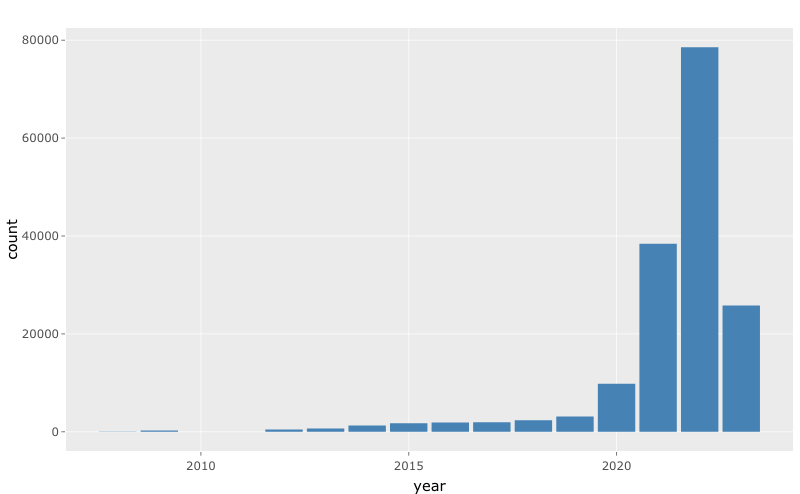
The chart below shows that the number of videos uploaded in 2022 was almost twice the number in 2021. The annual total reached an astonishing 78,570 videos—an average of 208 new videos every day. By the end of the first three months of 2023, the total was already approaching the full-year figure for 2021.
Videos Whose Titles Contain “Contrast”
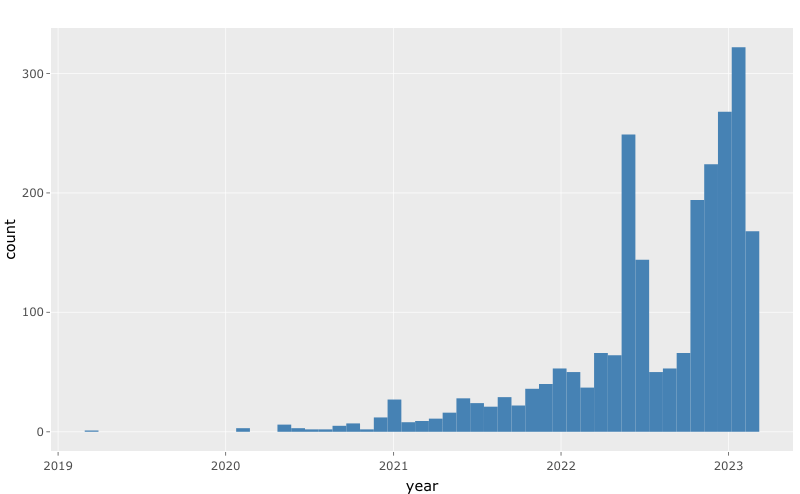
I searched all video titles for 「反差」 and plotted their distribution over time. The earliest matching title appeared in 2019. Starting in 2020, the number of these uploads rose rapidly, although part of that increase naturally came from the growth in total video uploads.
Percentage of Monthly Videos Using “Contrast”
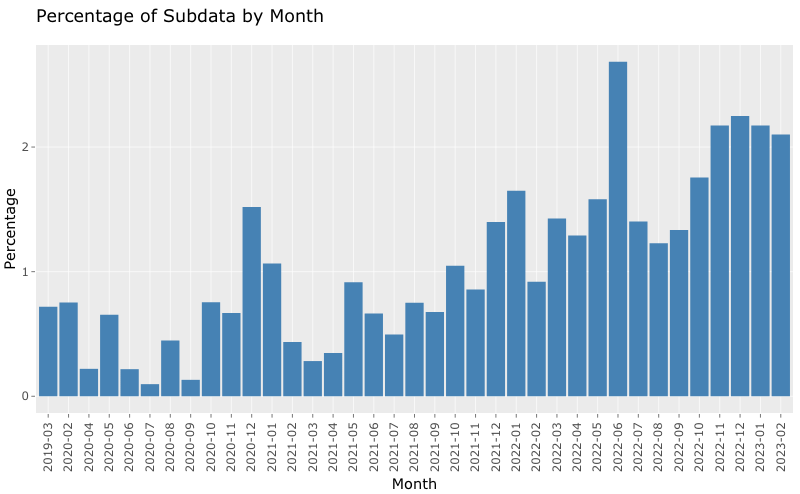
To determine whether use of the word itself was increasing, rather than merely following the platform’s overall growth, I compared the number of titles containing 「反差」 with the total number of videos uploaded each month. The chart shows a clear upward trend.
Prediction Curve
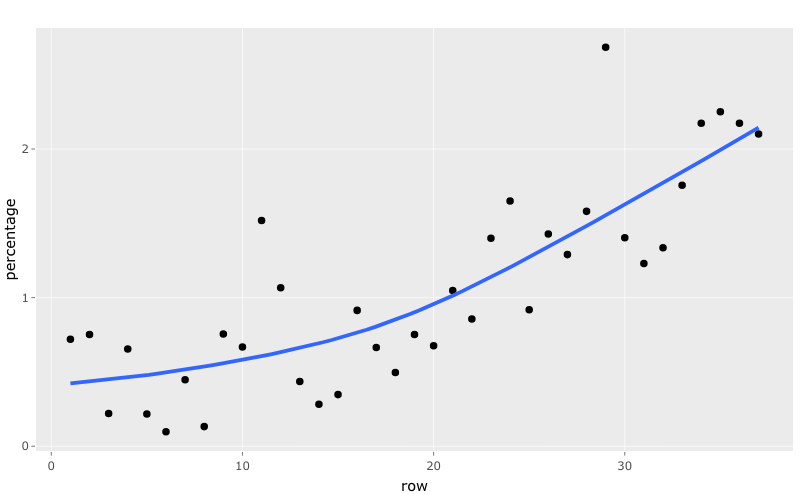
To quantify the trend and test whether it was statistically meaningful, I performed a linear regression. The chart uses a GAM rather than an LM so that the shape is easier to see. The resulting curve still shows a clear upward trend.
Model Summary
Call: lm(formula = percentage ~ row, data = merged_counts)
Residuals: Min 1Q Median 3Q Max -0.52706 -0.32540 -0.01723 0.27771 1.13483
Coefficients: Estimate Std. Error t value Pr(>|t|) (Intercept) 0.118441 0.135216 0.876 0.387 row 0.049364 0.006204 7.957 2.33e-09 --- Signif. codes: 0 ‘’ 0.001 ‘*’ 0.01 ‘’ 0.05 ‘.’ 0.1 ‘ ’ 1
Residual standard error: 0.4029 on 35 degrees of freedom Multiple R-squared: 0.644, Adjusted R-squared: 0.6338 F-statistic: 63.31 on 1 and 35 DF, p-value: 2.327e-09
The model suggests the following:
- Each month, the percentage of all video titles containing 「反差」 was about 5% higher than in the previous month.
- A p-value below 0.05 indicates a significant linear relationship between time and usage. In other words, more videos used the word as time passed.
- The R-squared value indicates that 64% of the variation can be explained by the linear relationship.
“Contrast” and Favorites
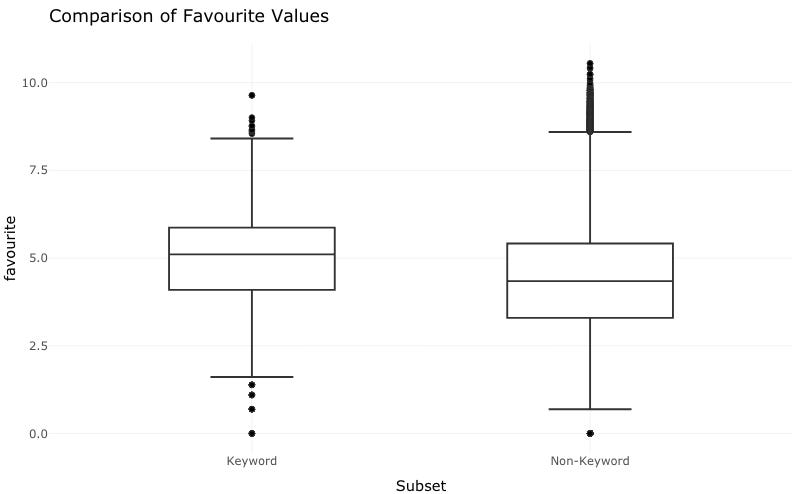
To understand why uploaders favor the term, I compared the number of favorites received by videos whose titles contained 「反差」 with those that did not. Both the average and the lower fence were higher for videos using the keyword. Because the range was extremely wide and many videos had very few favorites, I used a logarithmic transformation to make the comparison easier to see.
Welch t-test
To test whether the difference between the two groups was statistically significant, I performed a t-test comparing videos with and without the keyword. Because the groups were very different in size—about 1,300 versus 120,000—I used Welch’s t-test.
Welch Two Sample t-test
data: keyword_data$favourite and non_keyword_data$favourite t = 5.4023, df = 1409.3, p-value = 7.714e-08 alternative hypothesis: true difference in means is not equal to 0 95 percent confidence interval: 88.49094 189.39502 sample estimates: mean of x mean of y 421.6097 282.6667
The extremely small p-value indicates a statistically significant difference between the groups. Videos whose titles used 「反差」 also received nearly 190 more favorites on average than videos without it.
“Contrast” Compared with Other Words
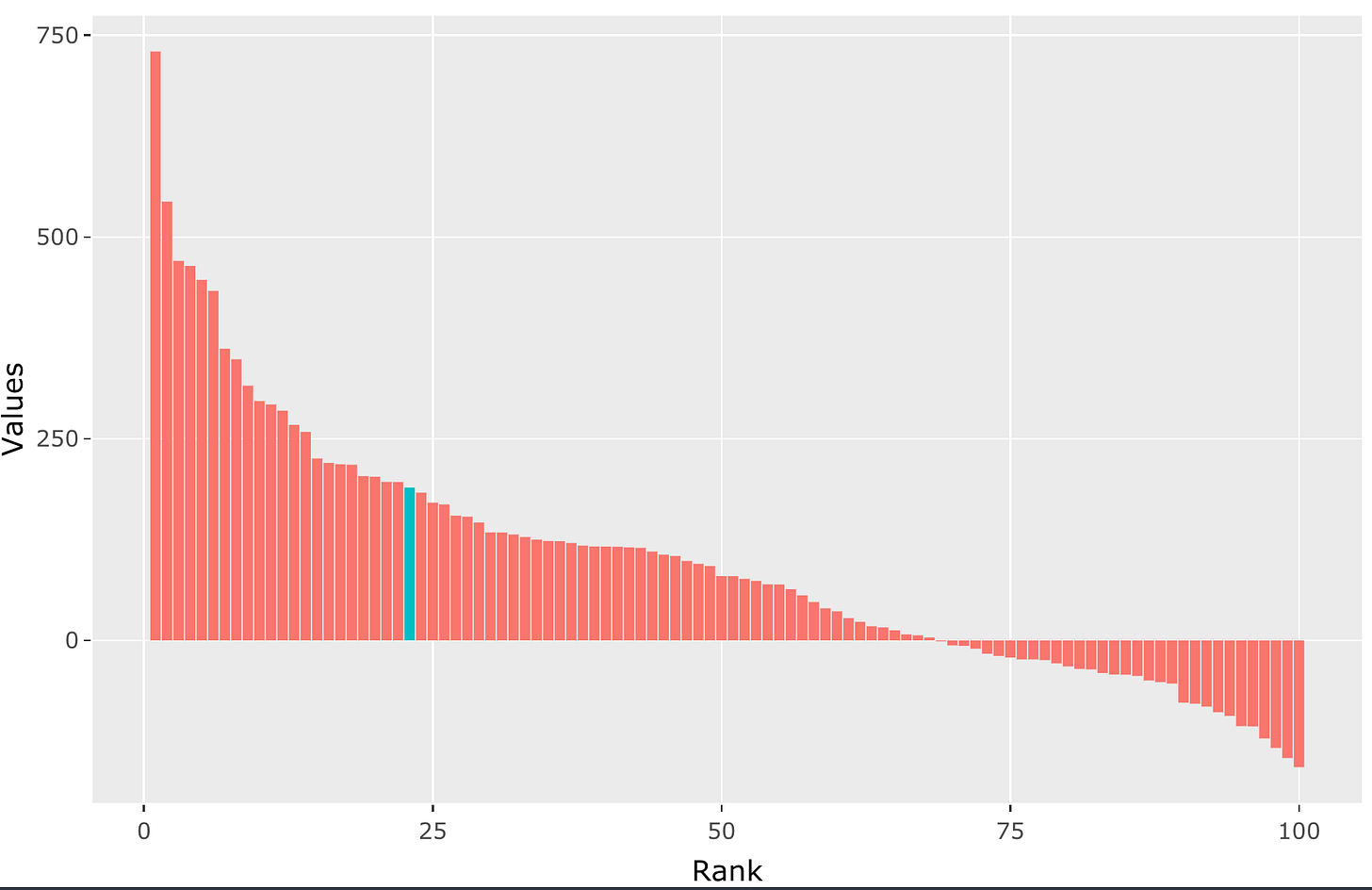
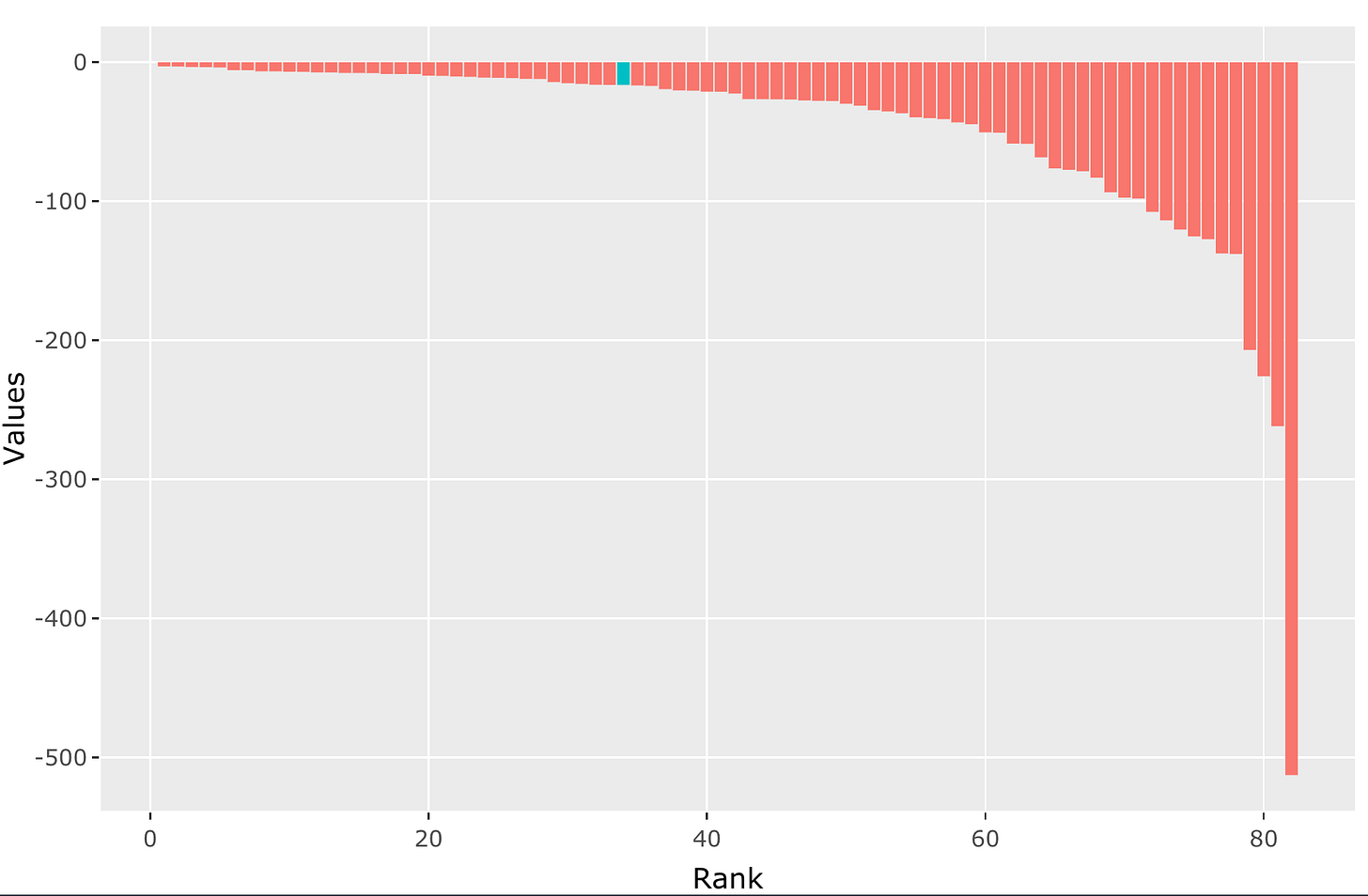
How did 「反差」 perform compared with other terms? I selected the 100 most frequently used words on 91 Porn and repeated the same t-test procedure for each one. I then ranked them by the increase in average favorites and by p-value, where a smaller p-value indicates a greater difference between the two groups. 「反差」 ranked near the top among the 100 high-frequency terms: 23rd for the increase in average favorites and 34th by p-value.
Conclusions from the Data
- Over time, 「反差」 became increasingly popular in video titles on 91 Porn, rising by about 5% month over month.
- Videos using the keyword received a statistically significant increase in favorites compared with videos that did not use it.
- Even among other high-frequency words, 「反差」 remained one of the terms most strongly associated with higher favorite counts.
The Key
The data supports a reasonable inference. After 「反差」 first appeared on 91 Porn in 2019, uploaders noticed—consciously or not—that the term could increase clicks and favorites, so they copied one another. I can observe a similar effect in my own Bilibili videos: videos with “Python” in the title tend to receive many more views. Eventually, someone realized that the sexual implication of 「反差」 was concealed enough for the word to be used openly on public social media.
On public platforms, the word works differently from the explicit examples at the beginning of this article, where both sides of the “contrast” are clearly stated. Instead, creators use it vaguely—sometimes in ways that do not follow Chinese grammar, or simply as a standalone hashtag. This vagueness is precisely what fixes the unstated side of the comparison in the direction of sexual promiscuity. The semantic shift did not make the word describe reality more precisely. It made the word serve pornography’s most important purpose: producing sexual arousal. These titles invite viewers to fantasize about women who seem difficult to approach in daily life, making it easier for them to project themselves into the content.
This ambiguity leaves many women completely unaware of what is being implied. Some even become participants in spreading the language. That is what frightens me more than openly insulting terms. It is as if ornamental birds inside a cage and the people outside it speak entirely different languages. The birds do not understand the spectators’ mockery, while some parrots even learn to repeat the spectators’ words and mock themselves. The discourse around 「反差」 creates exactly this situation. As someone standing among the “spectators,” that is what makes me uncomfortable.
「反差」 is only the most popular example; many similar phenomena exist. Imagine a woman who wants a discreet swimsuit, so she buys a plain one without decoration. At the pool, however, the suit attracts more strange looks—the opposite of what she intended. The reason is that its simple design resembles the Japanese school swimsuit known as sukumizu. That style appears widely in anime, manga, and Japanese adult videos, to the point that it has effectively been turned into a fetish product.
This happened to someone I know. It took place many years ago, and she only learned the hidden meaning recently when she mentioned the incident to me. If we want to prevent similar situations, I have three suggestions:
- If you are a “spectator” who can empathize with the position of the “bird in the cage,” take the initiative to explain hidden implications when someone is placed in an embarrassing situation that only spectators understand.
- If you are the “bird in the cage” and find yourself in an uncomfortable situation, ask a trusted friend why people may be reacting that way.
- If you are a “parrot,” you do not need to feel ashamed of your past behavior. An information gap misled you. The next time a similar trend appears, first learn where it came from and what it means before deciding whether to use it.
I hope this article can become a key that opens the iron cage and returns the freedom and equality that belong to them.