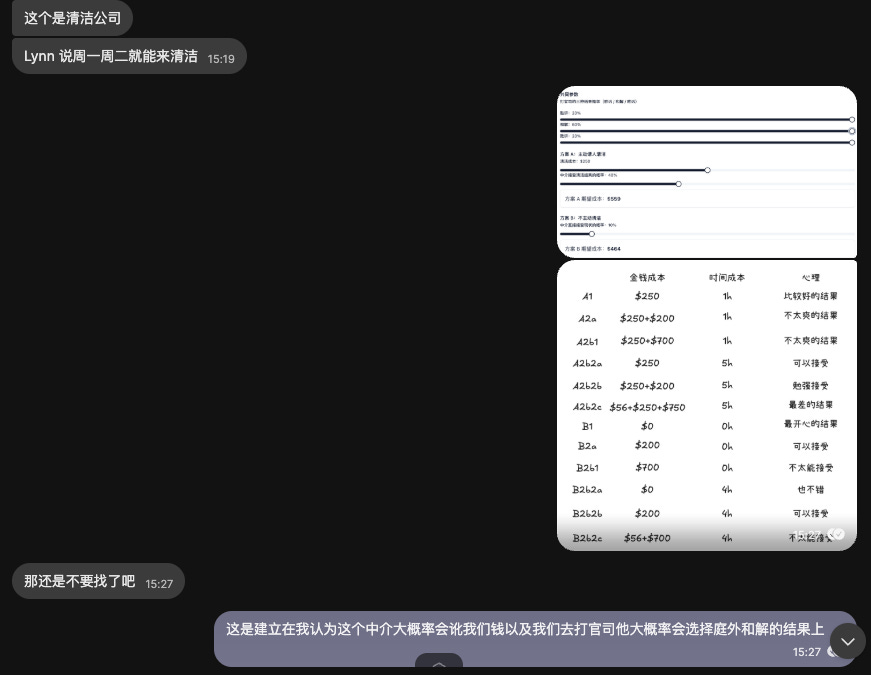
I need to move at the end of June, so I have a deposit dispute with the agent. At present, I know that there is an obvious stain on the carpet in the bedroom of the rental house, and I have been unable to completely remove it even after trying to clean it myself. I was faced with a decision: should I find an outside worker to help me spend money to fix the stains on the carpet, or should I just let it go and wait for the agency to ask for compensation after the check-out cleaning. (When you see this, you can think about this decision-making problem. It is best to record it and compare it after reading the article.)
I just recently read a book called "The Art of Decision-Making". This book is very obviously a reference book. After reading it, you can immediately use it according to the methods in it, so I tried to use the methods in it to help me solve this problem. This book proposes a decision-making framework: PrOACT: Problem (problem), Objective (goal), Alternative (optional plan), Consequence (consequences), Tradeoffs (tradeoffs). To put it simply, it is to analyze what the decision-making problem is, find out what goals you want to get from this decision, find as many alternatives as possible, analyze the consequences of each alternative, and then weigh all the alternatives uniformly. On top of this basic framework, you may also need to consider: Uncertainty (uncertainty), Risk Tolerance (risk tolerance), Linked Decisions** (interrelated decisions).
Now let’s try to use this decision-making framework to analyze the decision-making problem I encountered
- Problem: How to solve the check-out deposit problem
- Goal: I hope to solve this problem with the least money and the least time
- Optional options: Spend money to find someone to deal with carpet stains in advance
- Do check-out cleaning normally and wait for agency review
When predicting the consequences, I found that no matter which option it is, there may be several consequences, and I need to make new decisions in the face of different consequences. This is the linked decision mentioned above, and we need to rely on decision trees to solve it.
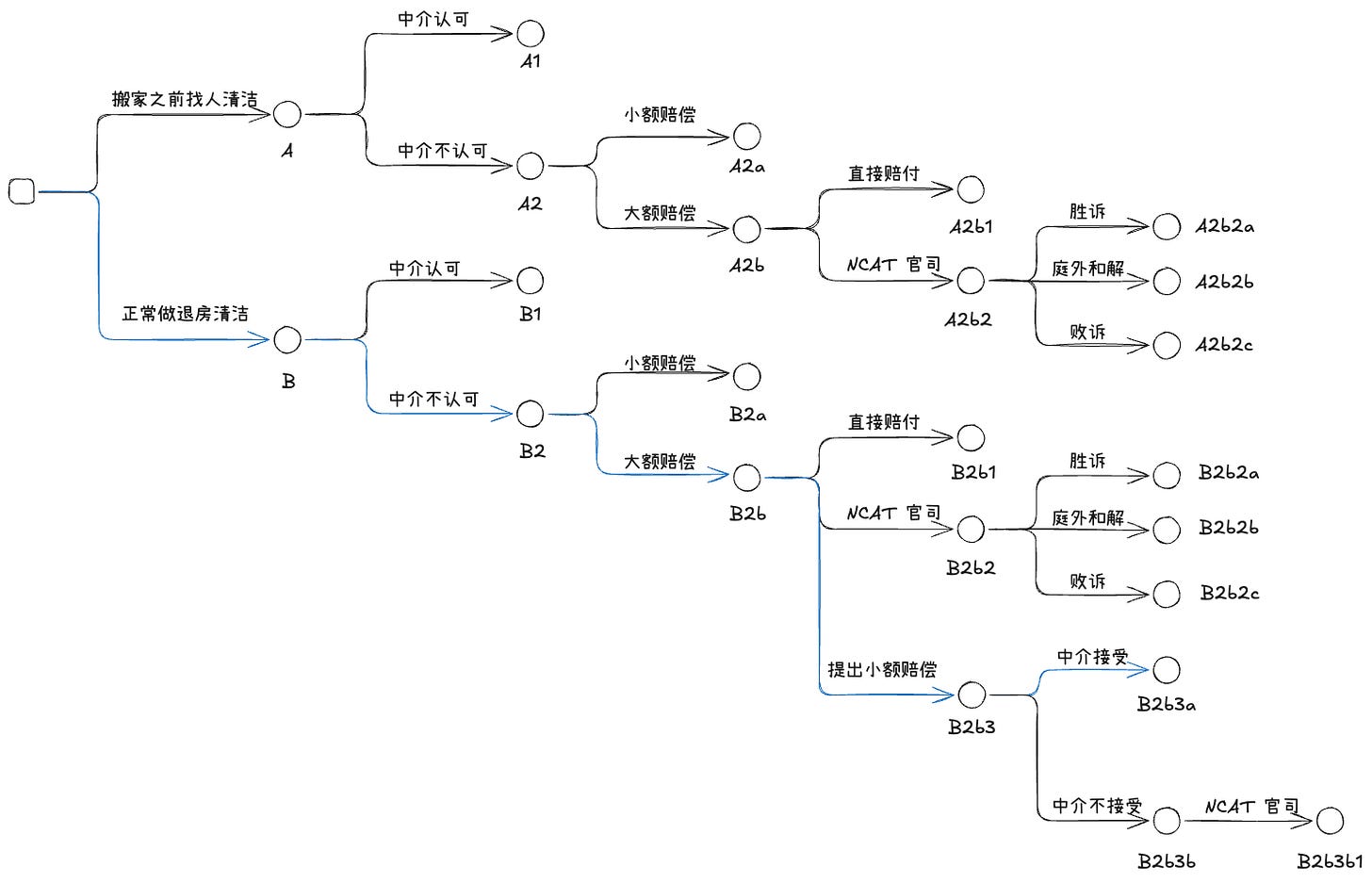
Both options may have two consequences: whether the agent recognizes the check-out status. If it is not recognized, there may be two types: reasonable small compensation, and unreasonable large compensation. For small compensation, if it is within my acceptance range, I think it can be paid. For unreasonable large compensation, I can choose to pay directly, go to court with the intermediary, or bargain with the intermediary. There may be three different outcomes of the lawsuit. List the entire decision tree step by step in this way, and number each possible outcome.
Now we need to weigh each result. The weighing is to compare how close the result is to our goal. Our goal is to spend the least amount of money and the least amount of time solving this problem.
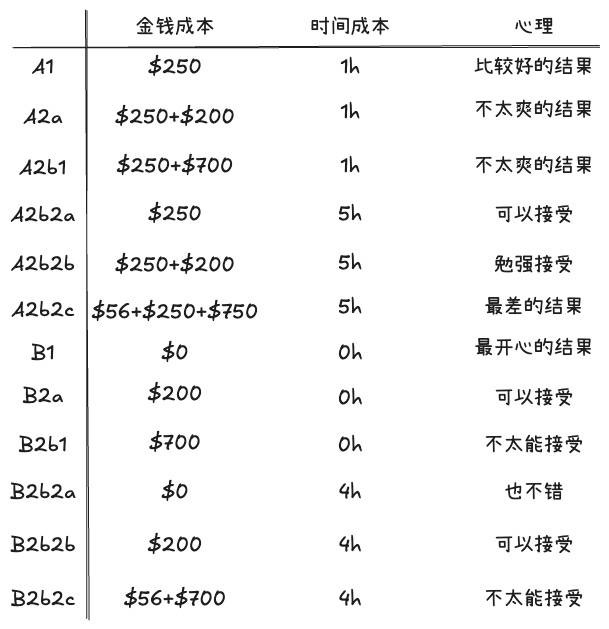
However, it is still difficult to make a decision so far, because there is uncertainty in predicting the consequences, and we do not know how it will happen in the future. But you can make a rough prediction by collecting information, adding a little certainty to the uncertainty. There are two main uncertainties in the decision tree: the first is the analysis of the human nature of the intermediary, and the second is the winning or losing of the lawsuit. Regarding the analysis of the human nature of intermediaries, I think that based on the inertia of Sydney intermediaries and my past rental experience, the intermediary will most likely want to deduct some deposits, unless the house is perfect. The second is whether to win or lose the lawsuit. I checked the relevant laws and found that carpets have very clear depreciation regulations. That is to say, even if the carpet needs to be completely replaced, I only need to pay the depreciation cost. The carpet depreciates 10% of its value every year, and my house is already 8 years old, so I only need to pay at most 20% of the original price of the carpet.
By collecting more information, I got two important pieces of information
- There is a high probability that the intermediary wants to steal my money (unreasonably large compensation)
- If I go to court, I will most likely win. Then the agency will avoid going to court with me and eventually choose to settle out of court, or accept a small compensation from me earlier.
With these two pieces of information, I think the final path will be very close: the intermediary proposes a large amount of compensation, I use the lawsuit as a bargaining chip, and the intermediary accepts my small amount of compensation. So there is absolutely no need for me to find someone to clean the carpet myself. After doing the normal check-out cleaning, I can follow the decision tree path one by one based on the agent's reaction.
The final result of this matter cannot be said to be similar, it can only be said to be exactly the same as what I expected. The agent asked for 400 yuan in compensation because of the stains on the carpet. I argued with him according to the law but he still asked me to compensate. When I asked to go to court for notarization, he reduced the compensation amount to 200 yuan. However, I gave the agent two options: 100 yuan in compensation or going to court. In the end, I only spent 100 yuan to resolve the matter peacefully.
Now that you have read the whole process, you should be able to gain a lot by comparing it with your own original ideas. In fact, this framework does not say how advanced it is, but many times when we make decisions, we cannot see the whole picture by simply relying on words and thinking. When the team makes decisions, they often argue about the uncertainty of the consequences of a certain plan. In fact, if you sit down with paper and pen to write down, it will become much clearer in many cases.