The idea of making this software
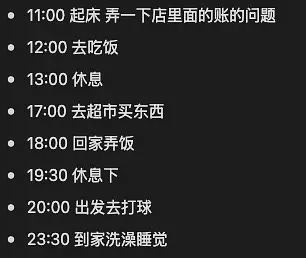
At the beginning of 2024, I wanted to plan my new year, and decided that I wanted to record my time usage during this year. I have used many time recording software (Timing, Toggle, Tyme) in the past, but in the end I was not able to stick to it. There are roughly two types of time recording software on the market, automatic recording in the computer background (Timing) or manually starting and ending a task (Toggle, Tyme). However, both of these recording methods have problems that I cannot persist with. Automatic recording cannot record time outside of computer use. At the same time, the automatically recorded time is too complicated and real, which leads to the unwillingness to continue recording. Manual recording simply requires an operation to start recording the time and an operation to end the recording for each task, which leads to frequent forgetting. In the end, my choice was to use intermittent diary to record. Intermittent diary is very simple. You only need to record each time stamp and attach a brief text. Intermittent diary can not only help record the usage of time, but also help us organize our thoughts and switch to the next task. After completing the daily recording, we only need to calculate the time difference between the two timestamps and then classify them.
After solving the problem of time recording, I want to solve how to optimally execute all tasks. I have used a lot of task management software in the past (Things3, Omnifocus4, Tick List, Sorted), but these task management software are essentially a task list. When I actually execute the task, I still need to think about what kind of tasks should be executed first. In order to solve this problem, I turned my attention to the Eisenhower matrix that solves task priorities, which is what we usually call the emergency importance matrix (dividing tasks into four quadrants according to urgency and importance). However, this matrix still has two problems that cannot be solved. The first is that there is still no priority for tasks in the same quadrant, and it is still necessary to think about what tasks need to be executed first. The second problem is that this matrix does not take into account the resources (time or money) spent by the task. For equally urgent and important tasks, if a task costs less, the task with lower cost must be completed first. So in the end, I changed the urgent importance matrix into a scoring system of urgent cost importance to score tasks. The scoring can sort the tasks and solve the problem of task priority, while adding the dimension of cost. Since this scoring system is too complicated, I won’t go into too much detail here. If you want to know more, you are welcome to take the test.
After solving the above problems, I recorded time throughout the year of 2024. At the same time, I initially used Python to build a system to help me conveniently record time and review data.
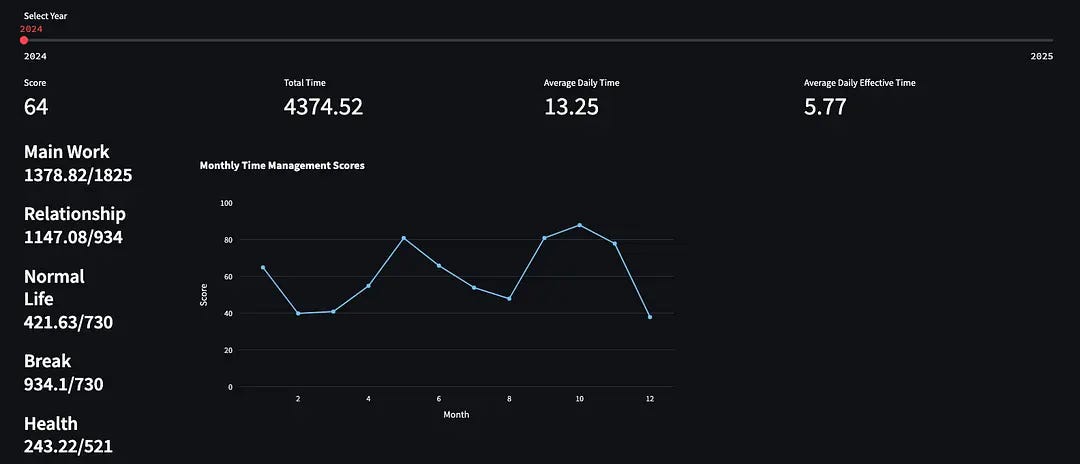
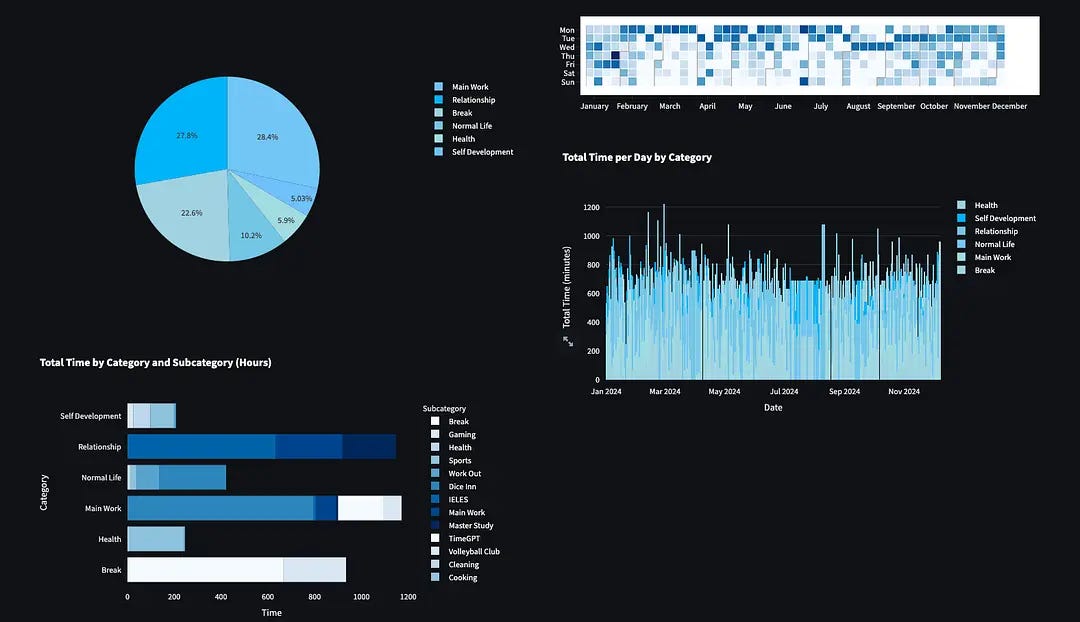
Recording time throughout the year has been very rewarding for me. I was able to clearly see how much time I was investing in different projects, which gave me a deeper awareness of my time. In the past, when we talked about the time it took to learn a skill, it was often just a general statement like "I learned it for five years." However, five years is simply the time span to learn the skill, not the actual time invested. For example, if you study two hours a week, you will study a total of 520 hours in five years; if you study two hours a day, you will study 3,650 hours in five years. The level of competency ultimately achieved in these two cases is quite different.
Time recording allows me to clearly see my actual investment in a certain goal, without feeling regretful because I have learned a skill for two years but made little progress. Generally speaking, the reason why progress is not obvious is not a problem of time span, but not enough time actually invested.
Software Introduction
I have felt again in the past year that task management and time management are actually inseparable, but there are few software on the market that combine the two well. So after I implemented it for 9 months, I thought this system was very helpful for time recording and task management. In September 2024, I decided to fully integrate this system into an IOS APP so that more people can use it.
The software is divided into three main modules: diary, vision, and data.
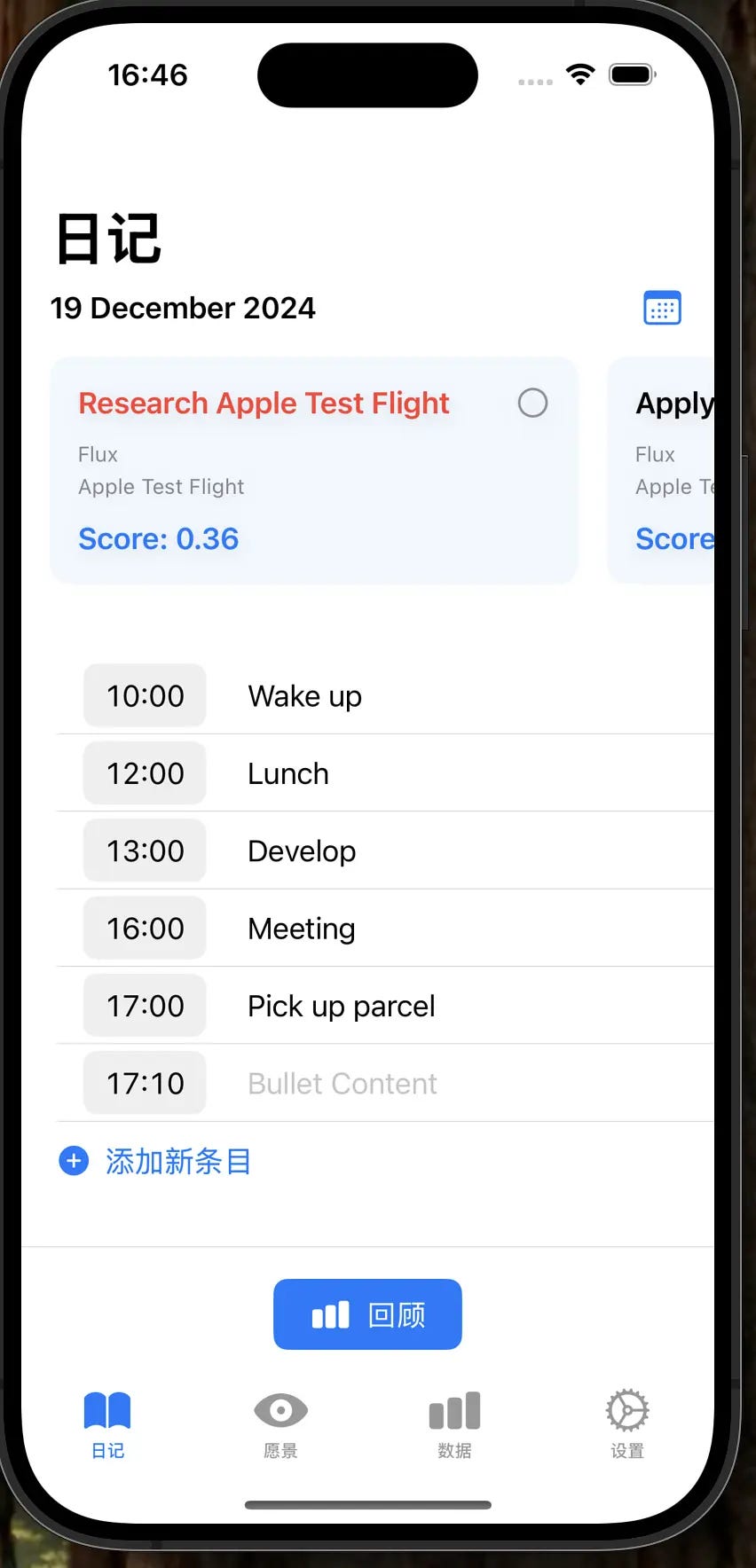
- The diary is mainly responsible for time recording and task recommendation functions
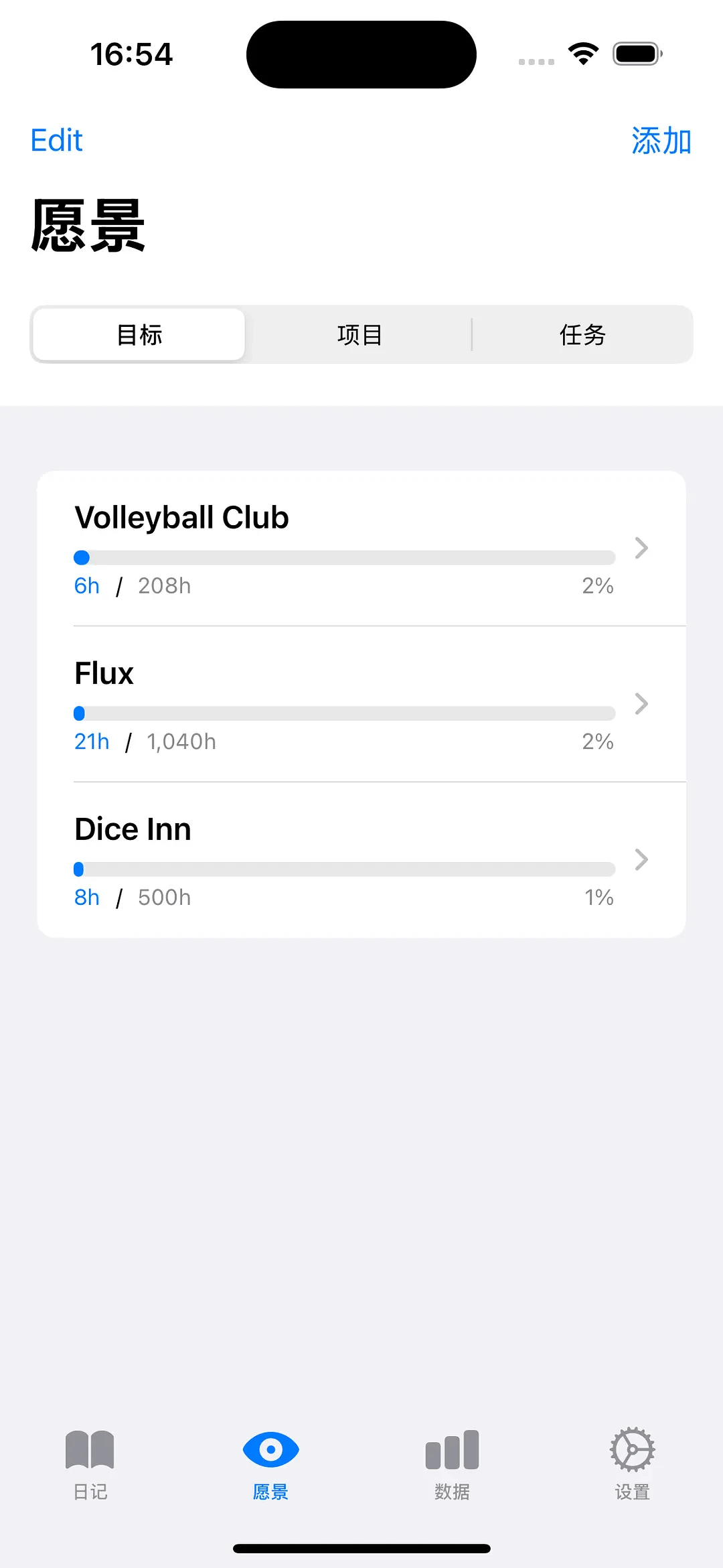
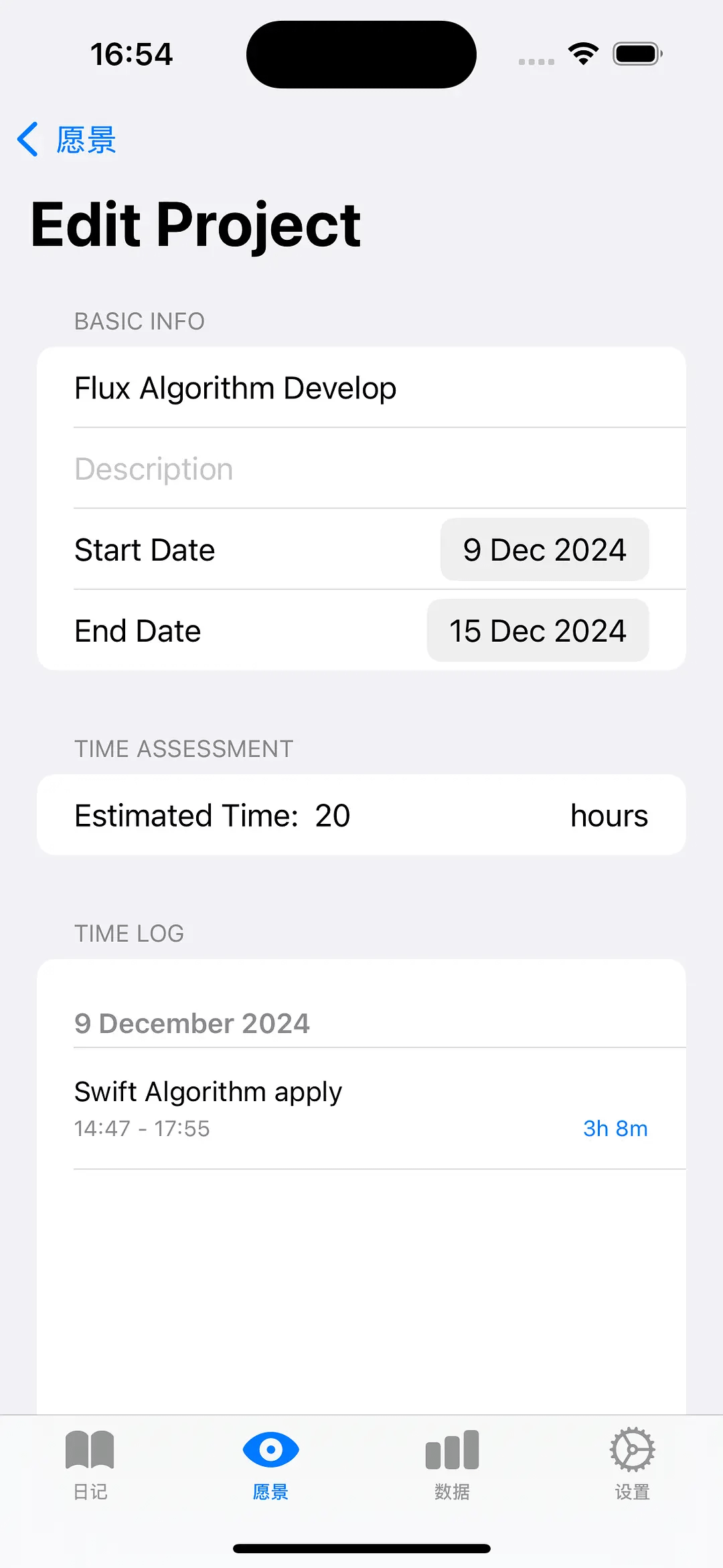
- The vision is mainly to split our goals into small projects and then smaller executable tasks, and there are also some settings for the task recommendation system
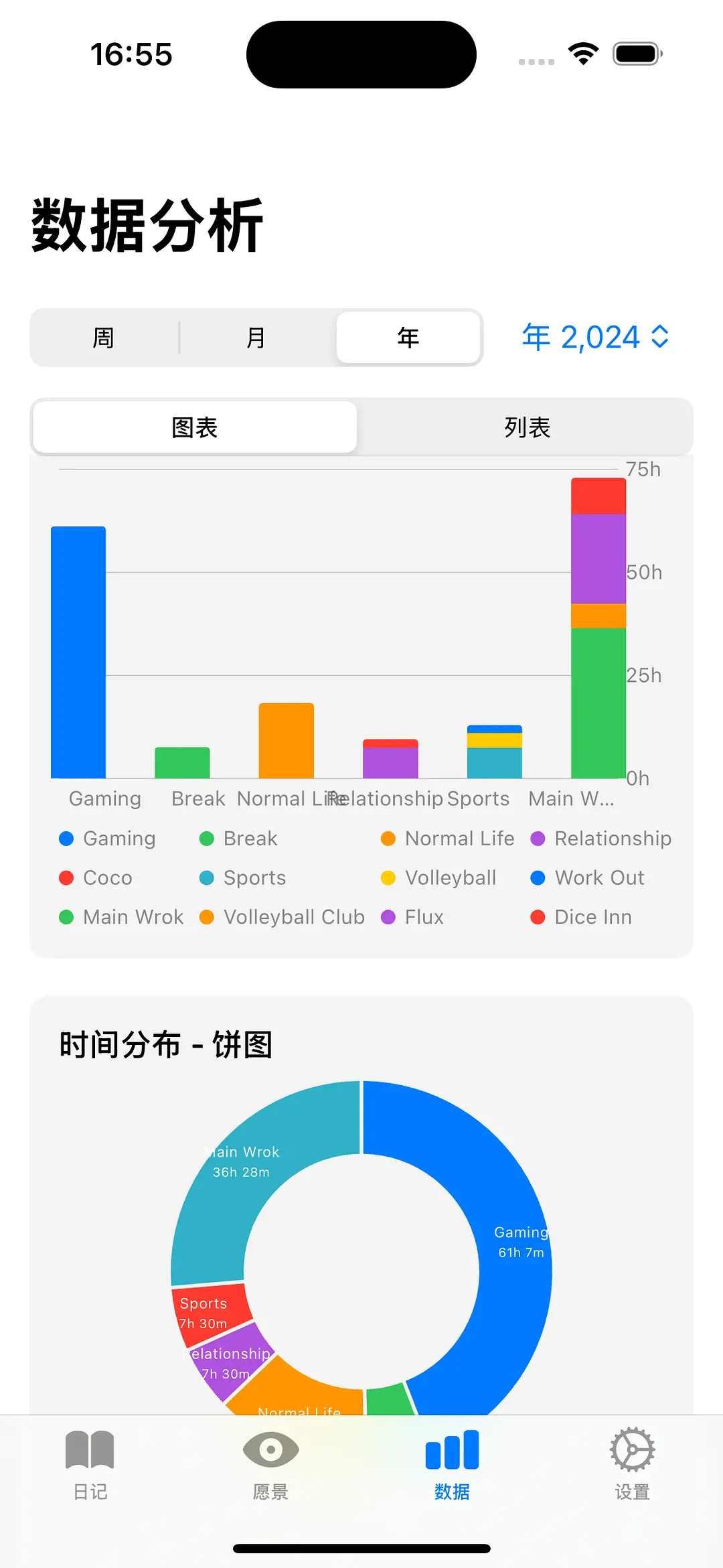
- The data mainly reviews our time recording results, allowing us to have a more macroscopic understanding of our time allocation
Diary
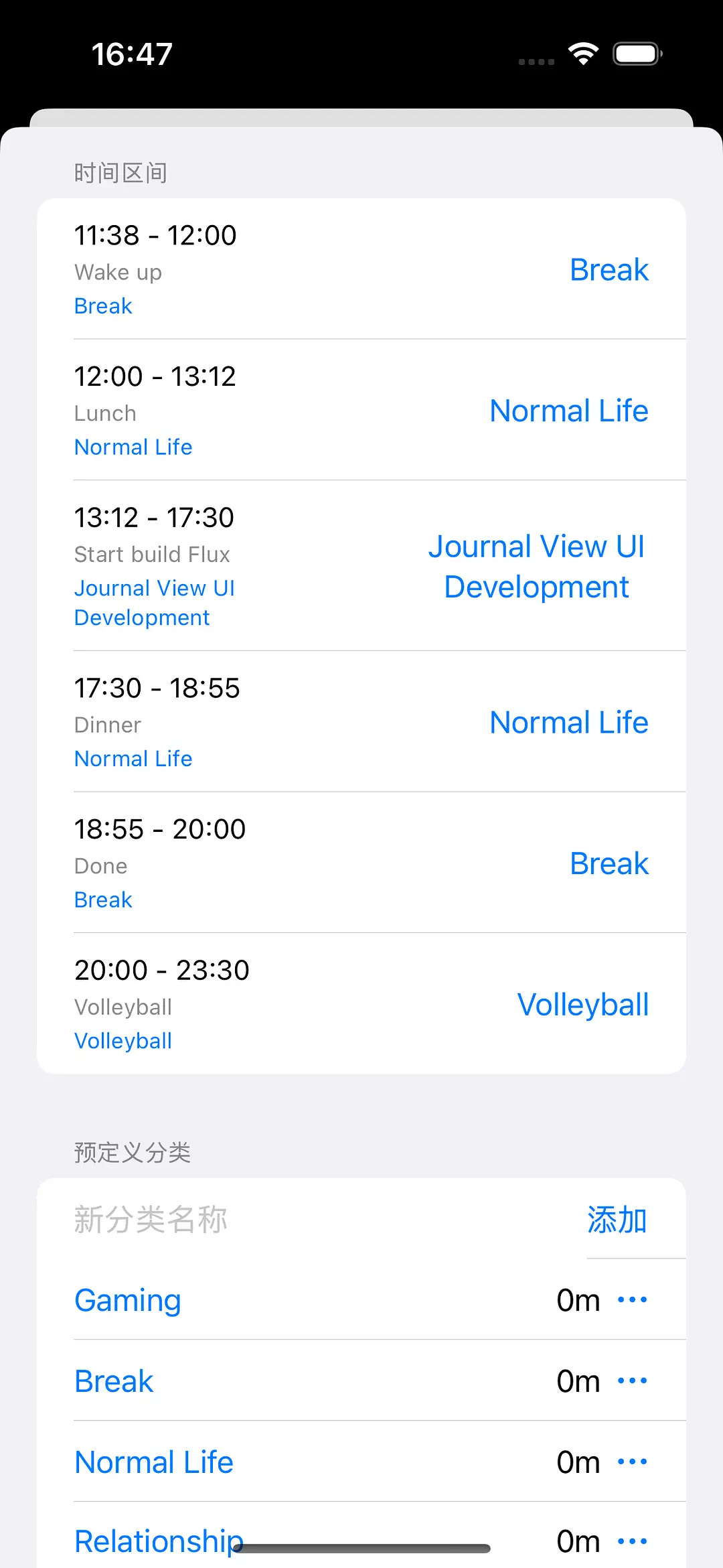
The diary is the part of the intermittent diary we mentioned above. It can record the time span of each day and the thoughts at that time. At the end of each day, the time periods can be classified. The classification of time periods can not only be classified into some preset time classifications, but also can be classified into tasks set in the subsequent vision. Tasks recommended by the algorithm can also be seen at the top of the diary.
Vision
In the vision module, the software will have three levels: goals, projects, and tasks. After setting the goal in detail first, and then continuously breaking it down into small projects, and finally to the final executable task, this process can help us better think about the path it takes to complete a goal. At the same time, because a certain time period can be assigned to specific tasks in the diary, we can also better review the time we spent on a certain goal.
Data
Finally, in the data module, you can clearly see your time usage through different views. Time classification is also linked to our goals. When setting goals, we can choose which large time classification a certain goal belongs to, and ultimately it can be displayed in the data.
Test
Currently the software can only be used on IOS, so if you want to participate in the test, please make sure that your device can be used. At the same time, the software is still in a very early stage, and there may be many unexpected bugs. At present, even for functional testing, it may not be able to be used as a long-term software. Please leave a message below to tell me what you think. If you really want to use this software, you are also welcome to participate in the test.