Two things that happened recently gave me a new understanding of time management and self-assessment.
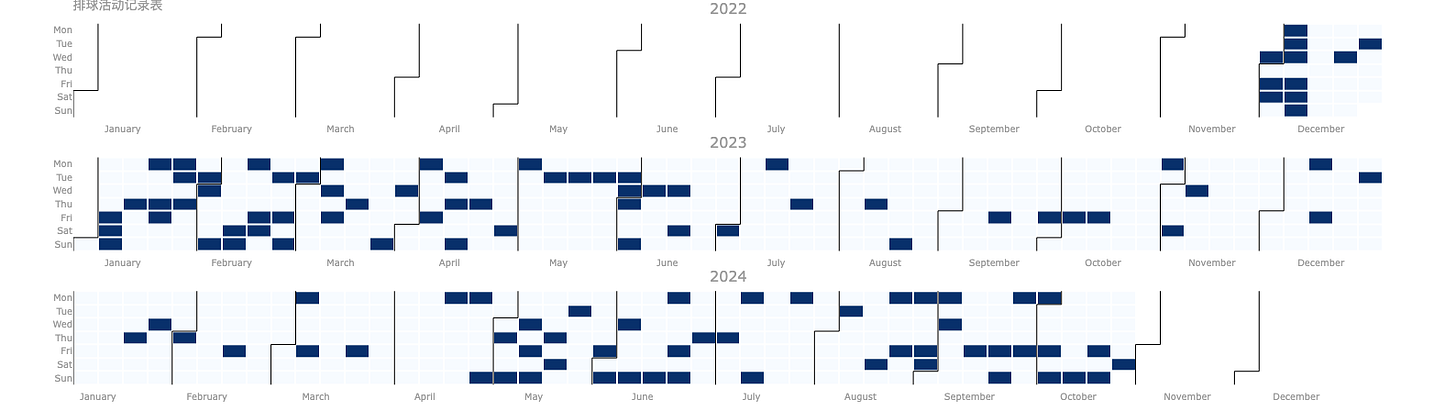
The first thing is about my experience playing volleyball. It has been almost two years since I started contacting volleyball in November 2022. Looking back on this time, I tried to keep track of how often and how long I participated in volleyball activities. Since each activity has a payment record, data statistics become very convenient. The final result shows that in the past two years, I participated in a total of 143 volleyball games or training sessions, averaging about 2.5 hours each time, and a total of about 350 hours.
The second thing is related to the anime "Lonely Rock" that I watched recently. It took the heroine in the play three years from starting to learn guitar to mastering it. However, many viewers in the barrage lamented her "extraordinary talent" and even said that they had not reached the same level after practicing for seven years, but ignored the key fact that she practiced for 6 hours after school every day.

Although this is just a fictional anime plot, it reflects a common problem: when most people evaluate their abilities and time, they tend to only consider the time span and ignore the effective length of real investment.
According to the "10,000-hour rule" proposed by K. Anders Ericsson, it takes 10,000 hours to practice a skill to a world-class level. Comparing the above two examples, I initially thought that I had invested a lot of time in volleyball over the past two years, but in fact, these 350 hours were just a drop in the bucket compared to 10,000 hours. Although my goal is not to reach a world-class level, if we only look at the standard of 10,000 hours, this time is obviously far from enough. In "Rock of Loneliness", the heroine practices 6 hours a day, a total of 6570 hours in three years, which is indeed enough to support her to reach an extremely high level.
Many people only remember the years they engaged in a certain skill, but do not realize that the effective time they really invested is insufficient. When they see the achievements of others, they often describe them as "gifted" and ignore the effort and time behind them.
So, does talent matter? The answer is yes. Talent determines the efficiency of learning, but efficiency and time complement each other. No matter how talented you are, it won't help if you don't invest enough time. Even if your talent is better than average, it still takes a lot of time to reach an excellent level in a certain skill.
According to the "80-20 rule", we may only need to invest 20% of the time to master 80% of the basic skills. However, if you want to improve on the remaining 20% and get close to world-class level, you usually need to invest an additional 80% of your time. In other words, even if you don't pursue world-class skills, the average person needs to invest at least 2,000 hours to reach a high level of competency in a certain skill.
So, have you really invested these 2,000 hours in a certain ability of yours?