
Growing up, we have almost all heard similar words:
- "Read more."
- "Work hard."
- "Persist in doing things."
There is nothing wrong with these words, but the problem is that most children do not really understand: Why study? Why work hard? Why persist?
More importantly, many adults actually don’t know clearly. They just knew the words were true and passed them on from generation to generation. Regarding reading, the ancients said that "books have their own houses of gold"; regarding hard work, the ancients said that "God rewards diligence"; regarding persistence, the ancients said that "perseverance can carve gold and stone."
But most of these words are conclusions, not reasoning processes.
A person who truly understands something and is willing to do it cannot just stay at "other people say so", but must be able to deduce it and know why, only then can he understand it and do it only when he understands that it is beneficial to him.
I think the most useful thing in basic education is mathematics. Many people don’t like calculations, not because they don’t know how to calculate, but because they don’t want to think. A very common scenario is: you ask a person about how much it costs, and he says "it's hard to say"; you say "just a rough estimate", and he says "it's not that precise"; but if you continue to ask and break down the conditions, he can often give a number in the end. The problem is not that I can't figure it out, but that I'm too lazy to push forward the thinking.
What I want to say is: Reading, hard work and persistence, these three words we have heard since childhood, can actually be "calculated" using "time".
1. To understand these three questions, you must first understand one thing: time is the most basic means of production
People can obtain results, whether it is food, skills, income, or more abstract abilities, which are essentially inseparable from the investment of time.
In primitive times, people spent time learning to hunt and gather, and then spent time applying these skills to survive, thus obtaining food and resources. Whoever has stronger skills can get more rewards in the same time.
In modern society, this structure has not changed, it has just become more complex. We still need to spend time learning skills and knowledge, and passing university tests to get a diploma. We then rely on these diplomas to get jobs, and then sell our time at work to provide value to the company. The company obtains resources from nature, seeks needs from society, produces products or provides services, and these products or services are exchanged for money, which is finally given to you as wages. So in essence, we still rely on time to exchange for wealth, but in today's society we have leverage. Simply selling time is a linear exchange for money, but this part is beyond the scope of our article.

Understanding this, we can look back at those three questions.
2. Why study? Because reading is reusing other people’s time at low cost
Let’s talk about reading first.
Many people understand reading as "obtaining information", but this is actually too underestimated. The more important meaning of reading is: It allows you to use very little time to absorb the cognitive achievements that others have spent a lot of time to accumulate.
A book, in the short term, is the compilation of several years of experience and thinking by the author; in the long term, it may be a compressed expression after decades of study, work, and research. In order to formulate the opinions in the book, the author often reads a lot of information, takes many detours, makes many mistakes, and repeatedly corrects his understanding. As a reader, you only need to spend a few hours reading and a period of time to digest before you can come into contact with this set of refined results.
Here is a question that is easily overlooked: Why don’t you just watch short videos and read tweets? Can’t these also be used to obtain information?
The difference is two things.
The first is content density. The production time behind a short video or a tweet is often only a few minutes to a few hours. The amount of information it conveys is basically equivalent to the time invested by the author, or even less. Behind a book is the author's years of accumulation. After reading it, it is equivalent to unlocking the cognitive compression package formed by other people's long-term investment at a very low cost. The information density of the two is not at the same level.
The second is Quality Screening. Short videos and tweets are filtered by algorithms and traffic. What is popular may not necessarily be valuable, and what is valuable may not be popular. A good book that can be passed down has often been double verified by time and a large number of readers - it can be read and quoted repeatedly, which itself is an endorsement of quality. When you read this kind of book, the choice itself has helped you filter out a lot of low-quality information noise.
Therefore, the value of reading is not just "what you know", but it significantly improves the efficiency of your time use. To a certain extent, you can be said to be "stealing" other people's time and reusing the results of other people's long-term investment at a very low cost.
This is a more understandable version of "The book has its own golden house". It is not the book itself that will turn into wealth, but the high-density, verified knowledge in the book that will help you improve your productivity per unit time. In the long term, this improvement will naturally translate into higher competitiveness and more opportunities.
3. Why should we work hard? Because there is not enough time investment, most abilities will not be formed at all
Let alone effort.
Working hard is often talked about in a very moralistic way, as if hard work itself is a virtue. But from the perspective of results, the simplest meaning of effort is actually: investing time. **
Of course, a person's ability improvement depends not only on time, but also on talent, methods, feedback, environment and resources. Strictly speaking, ability growth is more like this relationship:
Ability = time investment × learning efficiency
Learning efficiency also includes factors such as talent, methods, and training quality.
So I don’t think “you can definitely surpass anyone as long as you work hard”. The reality is not like this. Talent differences are real, and resource differences are also real. Some people have a higher starting point, some people give feedback faster, and some people have an easier time entering a good training system. It would be imprudent to completely erase these differences.
But the influence of talent has limits. For most people, the goal is not to become the top 1% in that field, but to reach the top 10% to 20%. Within this range, time investment is almost the decisive variable - the gap in talent can be completely covered by enough effective investment. In other words, many people think they have lost to talent, but in fact they have just lost to lack of investment.
Because in most fields, a person's initial level is often very low. At this stage, what determines whether you can go from "not good" to "somewhat good", and from "very poor" to "above average" is often not extreme talent, but whether you have enough effective time investment.
Taking endurance events as an example, the distribution of marathon scores is very illustrative. Of course, reaching the top level requires excellent physical conditions, long-term systematic training and strong self-discipline. This is not something ordinary people can achieve in a short time through hard work. But for most amateurs, the goal is not to reach the elite group, but to progress from "cannot run" to "stable finish", from "very average" to "significantly above average".
The following is data from a global study by RunRepeat covering approximately 19.6 million marathon results from 2008 to 2018
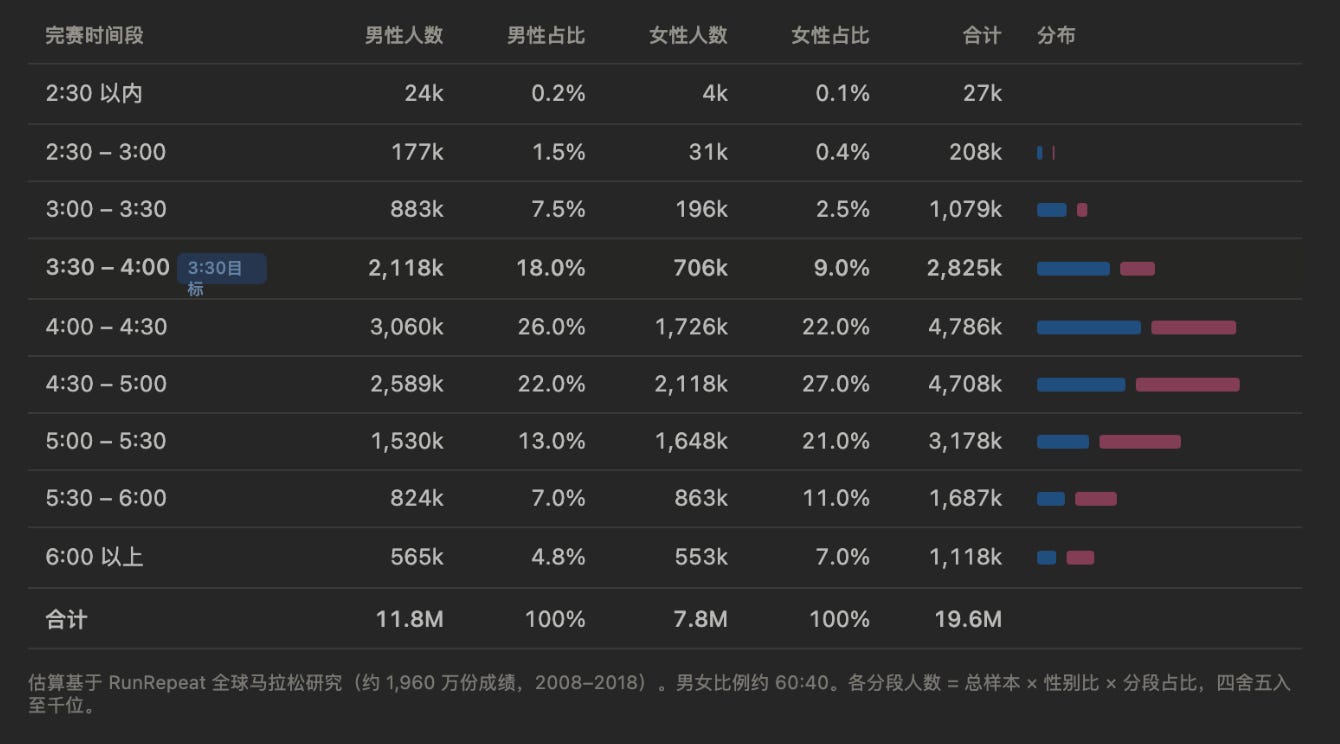
For most people, being able to reach the top 25%-30% (within 4:00 for men and within 4:30 for women) is a result that can be achieved through time and effort.
In other words, the meaning of hard work is not to ensure that you become the top person, but to give you the opportunity to enter a position that you would never have thought of in the air. **
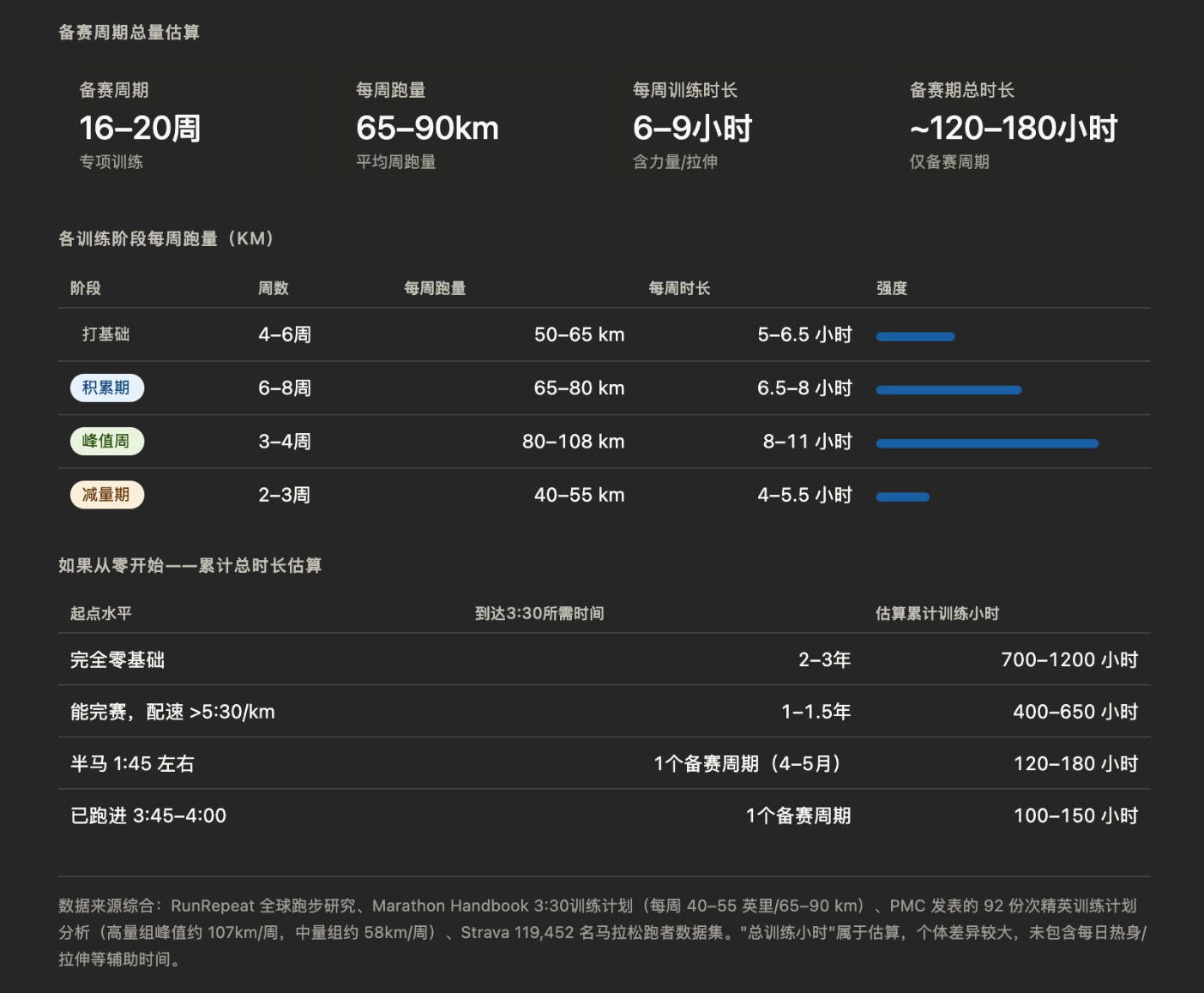
Many people actually lose not because of their talent, but because of insufficient investment. Without enough training hours, you won't be able to see your true upper limit. You think you have "no talent", sometimes just because you haven't invested enough to be worthy of judging your talent.
So, why work hard?
Because ability is not formed by desire, but by accumulation of time. Without time investment, most abilities will not grow on their own.
4. Why persist? Because ability growth is often not linear, low feedback in the early stage is most likely to make people misjudge themselves
If the answer you strive to answer is "why you should invest", then the answer you insist on is "why you can't stop after investing for a while."
Because human growth is rarely linear.
We have a natural misunderstanding about many things: we always feel that no matter how much we invest, we should immediately see the corresponding return. But in reality, the development curve of most abilities is not a straight line. In the early stages of training, because you are starting from scratch, you may get a very big return by investing 10 hours. However, after you have advanced for a period of time, you may get little results by investing another 10 hours.
Let’s take the above-mentioned marathon as an example. If we can only use the completion of the race as the criterion for judging performance at the beginning, we can see that the performance improvement at the beginning is very obvious, but after the pace enters 4:00, the performance improvement is not so obvious.
Marathon is just an example that can be quantified, but this structure of "high feedback in the early stage, diminishing returns in the later stage, and extremely difficult to break through at the top" exists in almost all fields that require long-term accumulation - language learning, musical instruments, writing, programming, etc.
Have you ever had this experience: When you first start learning something, you make rapid progress and you can feel obvious changes every few days; but after a certain stage, you feel like you are stuck in the same place no matter how hard you practice, and you even start to wonder if you have reached your upper limit?
This is not your problem, it is determined by the structure of ability accumulation itself.
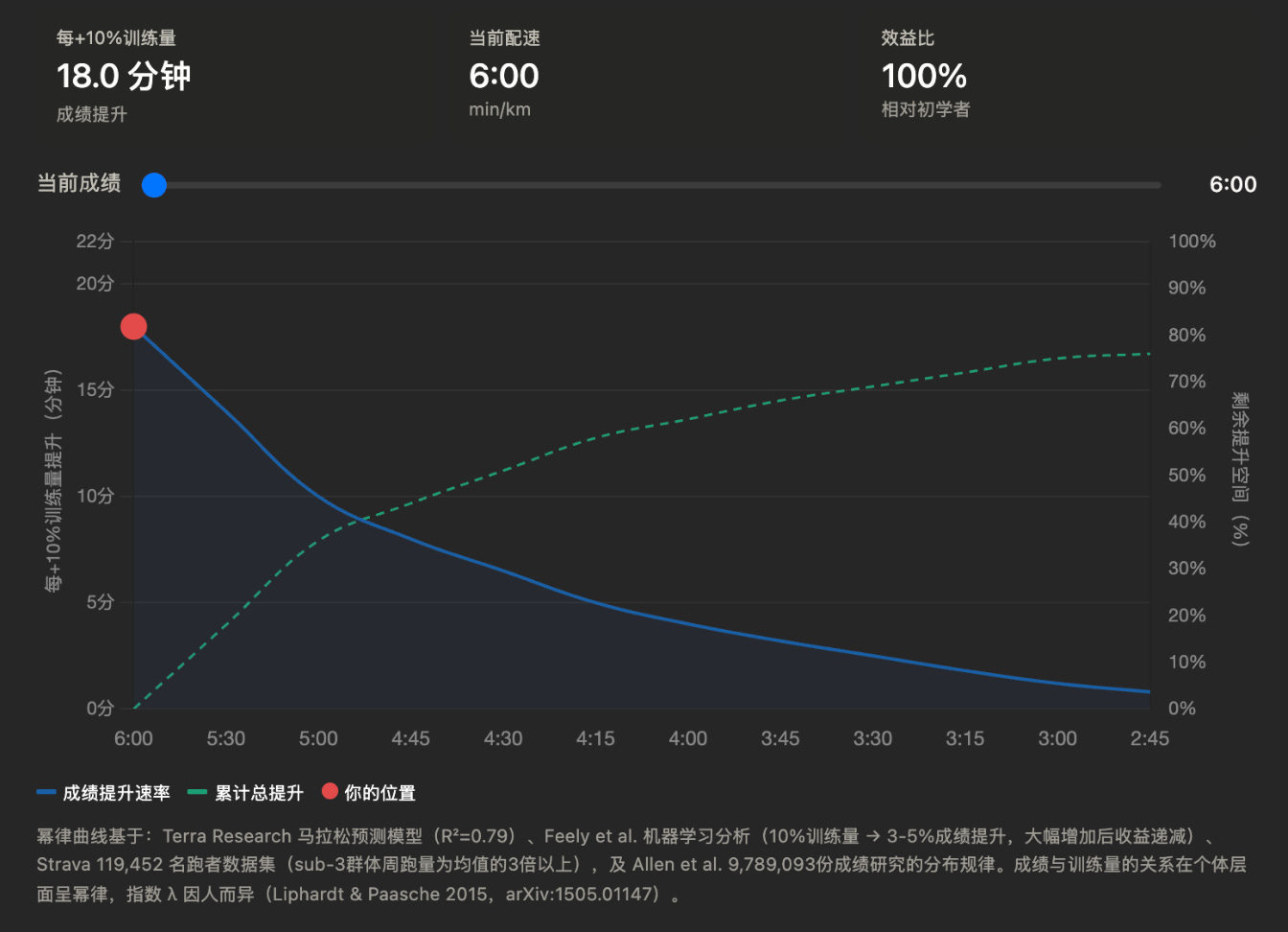
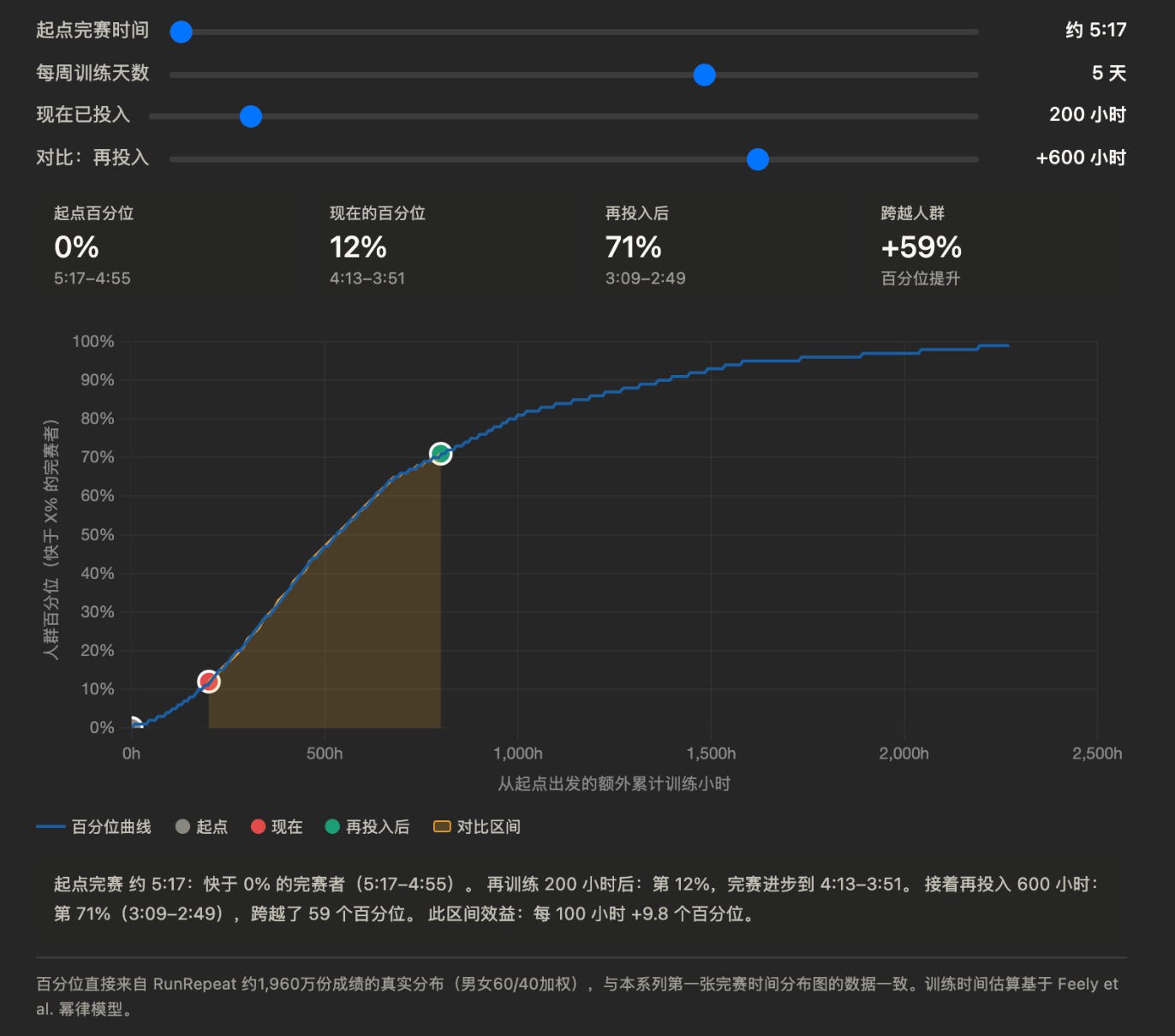
Your feedback was the most obvious at the beginning. You received a lot of feedback as you progressed from "no knowledge" to "beginner". But later on, you found that my progress was not so obvious and the feedback decreased. Gradually, you found that the return on investment of time was reduced and your progress slowed down. This is a very normal phenomenon. The figure below simulates the time it takes for normal people to increase from the 6:00 pace to the 4:00 pace at different stages. It only takes about 293 hours to increase from 6:00 to 5:00, but it takes an additional 845 hours to increase from 5:00 to 4:00.
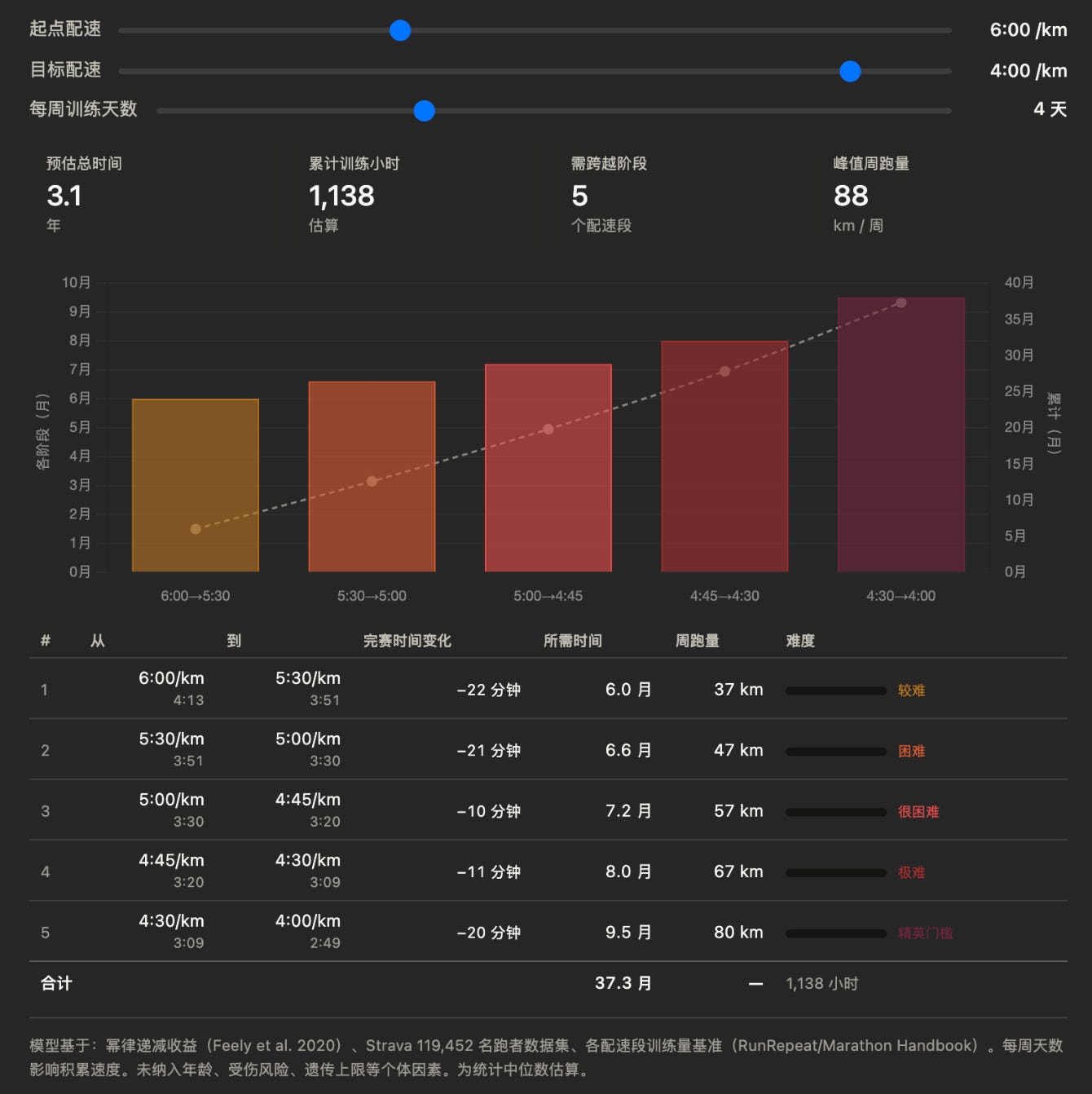
This is why you need to persist. If you only invest the first part of your time in everything and then give up, your level will always be only about the last 12%. But as long as you persist in investing 600 hours, you can reach the level of more than 71% of people.
5. Time is the currency you use to trade with the world
Back to the original question.
Why study? Because it allows you to reuse the cognitive achievements that others have spent years developing at a very low cost, directly improving your output efficiency per unit time.
Why work hard? Because ability does not grow out of thin air, but is accumulated over time. Without enough investment, you will never see your true upper limit.
Why persist? Because ability growth is not linear, the most difficult stage is often not the least valuable stage. Quite the opposite - low feedback in the early stage is when you are laying the foundation for subsequent acceleration.
These three questions are essentially the same question: Are you taking your time seriously?
Most people make the wrong effort, not because they don’t work hard enough, but because they never manage time as a truly limited resource. They repeatedly invest in low-efficiency things, dabble in high-return things, and choose to give up at the stage when persistence is most needed.
Time is the only thing that each of us has equally, and it is also the ultimate currency for our transactions with the world.
Reading, hard work, persistence, in the final analysis, are all answering the same thing: How do you spend this money.