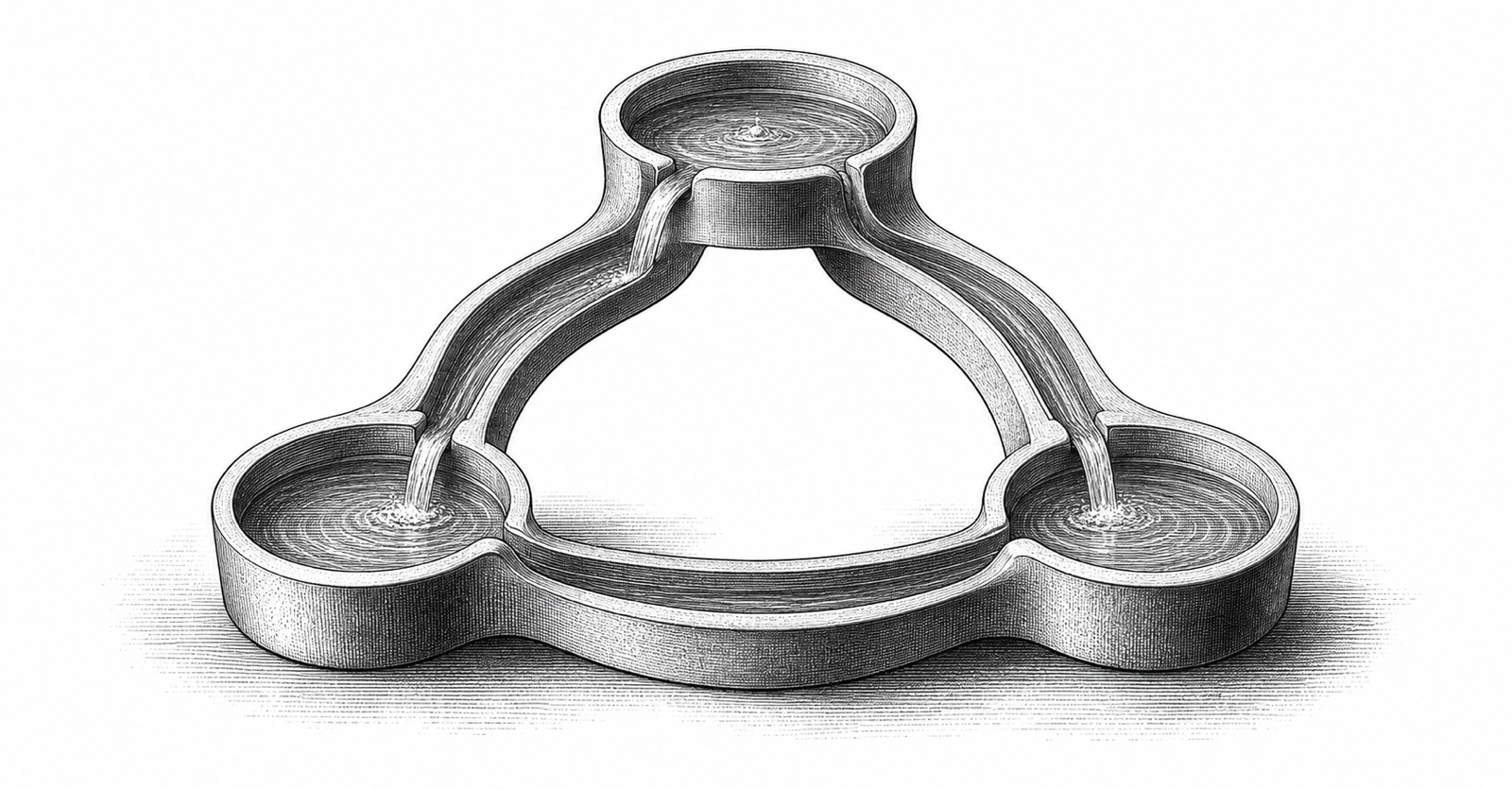
TimeGPT is a scientific and complete time and energy to-do management system. The entire system is designed to help everyone better achieve their goals. The entire system is goal-oriented, broken down into smaller projects and executable to-dos, and provides a complete UCEVI scoring system for to-do items; the scoring system is designed to maximize the realization of the highest-value goals, and ultimately intelligently arrange the time for to-do items based on the type of to-do items and energy areas. Time, energy, and to-dos can ultimately achieve a perfect positive cycle to help better achieve goals.
To-Do Management
UCEVI Scoring System
UCEVI It is the abbreviation of Urgent, Cost, Effort, Value, and Impact. This system is developed based on the Eisenhower Matrix, which is also known as the Urgent and Important Matrix. Simply put, the Eisenhower Matrix divides tasks into four quadrants and prioritizes them based on their urgency and importance. However, during my practice, I found that this judgment standard has the following two problems:
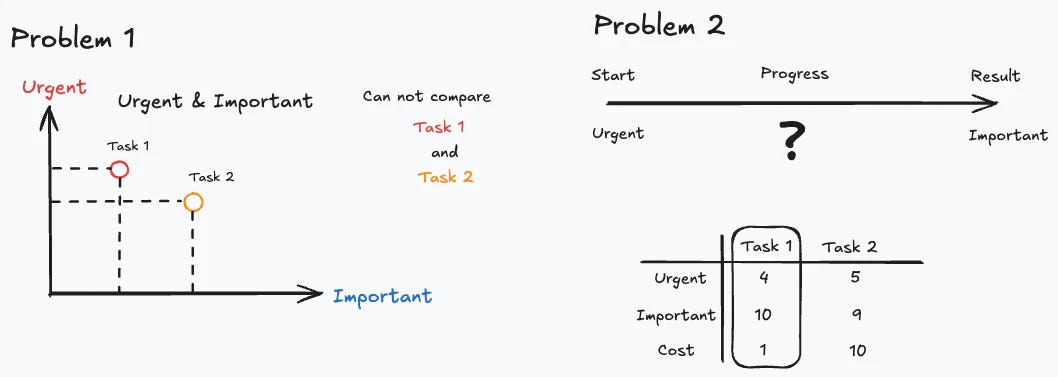
- There is no priority for tasks in the same quadrant;
- Urgency and importance are the starting and ending nodes of to-do items, but the process is ignored.
In response to the above two issues, I made some extensions to the Eisenhauer matrix. First of all, I asked that the final result be a scoring system, and there should still be priorities for tasks in the same quadrant.
Secondly, I added the consideration of the to-do process, that is, the resources required to be done. I added a new dimension: Cost, which is the time spent on each to-do.
However, there may still be some problems. The current three dimensions only focus on each to-do itself, and do not involve the superior projects of the to-do or the final general goal. In other words, if a to-do itself has a high cost and high importance, but the goal behind the to-do is not a very important goal, it is very likely that the final priority will be higher than a to-do that has a high cost but is an important goal.
Therefore, in order to add consideration to superiors, two new dimensions are added: Effort and Impact. Effort refers to the effort required to achieve the entire goal behind the to-do. The previous importance is broken down into the value of the to-do itself and the ultimate impact of the goals behind the to-do.
Finally got the following five different dimensions:
The beginning of the to-do depends on the urgency, the process depends on the resources that need to be spent, and finally the value that can be brought after completing the to-do. The following are the specific definitions of these five dimensions:
- Urgent: the urgency of the to-do
- Cost: the resources spent on the to-do
- Effort: the effort required to complete the goal (Goal) to which the to-do belongs
- Value: The value that the to-do can bring
- Impact: The impact that the goal behind the to-do can bring
Since it is a scoring system, we need to set a specific value for each dimension. If you simply score based on your own psychological evaluation (1-10), it is obviously not an objective scoring system. So for these five dimensions, we need to find the corresponding actual values for conversion, that is, the values we need to actually record. There will be different records for different levels.
- Urgent: the number of days from the current date to the deadline
- Cost: the time spent on the to-do itself
- Effort: the time spent on the goal to which the to-do belongs + the time spent on the project to which the to-do belongs
- Value: The time spent on the to-do accounted for the time spent on the total goal multiplied by the impact (Impact)
- Impact: The expected income if the goal is successful (income multiplied by the possibility) - The opportunity cost lost if the goal fails (the probability of failure multiplied by the hourly wage) + The mental pleasure brought by the goal
So far we have been able to obtain UCEVI Relatively speaking, objective data. Of course, there are still some coefficients that have not been explained. We will leave these to be solved later.
With this UCEVI data, we are faced with a new problem. For our to-dos, the influence of the dimensions in UCEVI is different for everyone. Some people may think that they have a lot of time and only value the final value, then they will think that the influence of cost and effort needs to be lower, and vice versa. It is not an objective and reasonable approach to give each variable a coefficient purely by yourself. In order to solve this problem, we need to introduce the analytic hierarchy process.
Analytic Hierarchy Process (AHP) is a decision analysis method. This method is mainly used for the analysis and decision-making of complex decision-making problems, and is especially suitable for problems that are difficult to completely quantitatively analyze. For example, if I want to buy a computer now, I may consider the following three aspects: CPU, GPU, and motherboard. However, my limited budget means that I cannot buy all the best ones, so I have to make trade-offs within a limited budget.
I compare these three variables in pairs. For example, I value GPU more among CPU and GPU, so I take 2 for GPU. In the comparison between CPU and GPU, I can only get 1/2. Finally, I obtained the following table:
Then I calculated the percentage for each column, and then added the total percentage to get the weight of each variable.
This kind of weight is still a weight we obtain subjectively (and indeed requires our subjectivity), but it is more objective than scoring variables purely based on our inner feelings. After calculation, we can get the weight of our UCEVI and multiply the weight by the variable to get our final score (there are also many normalization and inverse transformation operations).
How to define value
The value of different goals is different. Some goals may directly bring you money, but some goals may bring you a sense of accomplishment or a pleasant time. Let’s first discuss the more direct goal of obtaining money. This goal is generally more intuitive and should be the goal that most of us pursue.
Regarding money income, there are also two different types of income, one is one-time income and the other is the increase in annual income. The common way to compare a one-time income or an increase in annual income is to use the net present value approach, which is usually calculated using bank interest rates as the discount rate.
But there are still some problems if you just make a comparison like this. According to the current algorithm, the income that buying lottery tickets may bring in extreme cases is extremely high, compared with all other goals, so when calculating the real goal value, what needs to be calculated is the expected utility. Expected utility is simply the sum of the possible values of the final goal multiplied by the probabilities of their occurrence.
If a simple increase in annual income is used as the impact of the event, then the problem that may arise is that the increase in annual income from buying lottery tickets will be very high, but the probability that this event may occur is not considered, so the final decision is the outcome of the action (Action) that should be made in a certain state of the world (State). For each result, there is its own utility (Utility) function, and there is also a possible probability (Probability) to achieve such a result.
The final result is as follows. The expected utility of a certain behavior is the sum of the results of this behavior in different states of the world multiplied by the probability of occurrence.

The above method may be difficult to understand. Let’s take a simple example to understand. The decision of whether to take an umbrella when going out is related to the state of the world, that is, whether it is raining or not. Then different behaviors can produce different results corresponding to different world conditions.
Then different results have different utility for each person, and then the expected utility of a behavior can be obtained based on the probability that it will rain or not rain.
So in extreme cases, what may happen is that one of my goals may be to find a job that earns 10 million a year, so the priority of the projects and to-dos corresponding to this goal will be very high. But the possibility of this thing finally being realized is very low. We need to consider the possibility of this thing being successful in the current state of the world before making a decision.
The result obtained in this way will be much more reasonable than the previous increase in annual income. Maybe someone will ask at this time how to accurately determine the probability of each event. It is impossible to predict the probability of future events with complete accuracy, but these probabilities can change as you progress. As for the new probability, whether to use Bayesian theory to combine the prior probability and new conclusive evidence to update the probability, or Jeffries' updated probability after obtaining uncertain evidence, can effectively help us move further in the right direction.
These probabilities are related to many factors, your inner beliefs, and the state of the world. The probabilities given by different people for the same event may be completely opposite, but essentially they are to work towards the direction of your inner beliefs.
How to compare spiritual gains and monetary income
When setting goals, if the system only considers monetary income, then some goals that have no monetary income temporarily will never be considered. Some goals may be just for your own inner pleasure, such as developing some hobbies, fitness, etc., so at this time we need to consider spiritual gain and financial income.
The method used in TimeGPT is to introduce a lottery mechanism. Suppose you face a choice at a certain time, you can choose to go to work or play games at home. Generally speaking, when people can't make a decision, they choose to flip a coin. If it's heads, they go to work, and if it's tails, they play games at home. The lottery almost has a similar meaning, except that you can set the probability of heads and tails yourself.
For example, I want to compare going to work and playing volleyball. Then I made a lottery. The probability of 1/10 is to go to work and the probability of 9/10 to play volleyball. This makes me think that no matter which result of this lottery occurs, I will be satisfied. So in my heart, I want to play volleyball more than work. So the equivalent value of V is equal to a constant k divided by the probability.

The hypothesis is that if the probability is 1/2, we think that work and spiritual happiness are equal. So we get k = 0.5W.

It can be seen from the model curve that this model basically meets our needs, and will only rise significantly in extreme cases. At other times, it basically falls within the normal range around W.
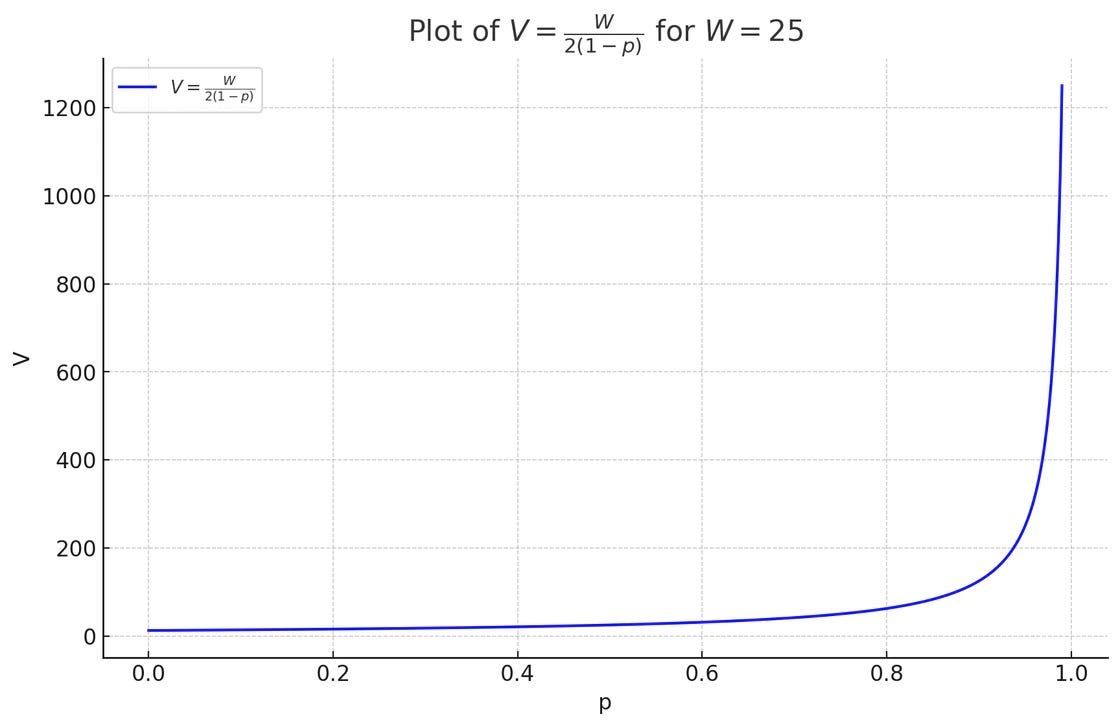
So for indirect income goals, you can use the time required to achieve this goal multiplied by the equivalent hourly income calculated by the above formula, which is equivalent to the fact that you get so many hours of pleasure and you get so much money.
Recommendation system
So far we have a corresponding score for all to-dos, but this still cannot satisfy our recommendation system. If you just sort by score, some problems may arise:
- The to-do may not have reached the start date yet, but it received a high score because of its final high value.
- Similar to-dos have the same score because they have the same goal or result.
- There is no way to make specific recommendations based on daily conditions.
In response to the above problems, we need to add some additional restrictions, but before that, the most important thing is to classify the things to be done. After a long period of practice, I divided to-dos into three types: tasks, reminders, and schedules. Their required methods are completely different:
- Task: Tasks that are not tasks with a clear time, such as completing surveys and research, etc.
- Schedule Event: events with clear time points, such as seeing a doctor, holding a meeting
- Reminder: Small tasks that need to be completed quickly, such as paying rent
. Among them, we are reminded that we do not need to score in our task system because they are usually very short-lived small tasks. Therefore, the following discussion will only cover the remaining two to-do types.
Tasks have no fixed start time and fixed duration. Correspondingly, the schedule has a very fixed start time and fixed duration. It is very important to clarify the types of these to-do items. If you do not classify these to-do items before, it will be a mess if they are all mixed together.
After classifying to-dos, we can make reasonable recommendations for different types of to-dos. There is no set start time for tasks, so almost any time can be an option. As for the schedule, if it does not arrive on the same day, then the schedule is meaningless because it requires a fixed time and will only happen when the time is up. For daily routines, we may have many routines at the same time, but only one daily routine is enough. Therefore, the recommendation system needs to choose whether there is a schedule for the day, and then use the remaining time to choose a reasonable combination of daily routines and tasks.
In layman’s terms, a recommendation system is able to schedule appropriate tasks for each day within a limited time. In fact, this sentence contains the restrictions of this recommendation system, limited time and appropriate tasks.
Limited time is the free time that can be used for control on the day. The appropriate task is to obtain the necessary schedule tasks and strive to obtain the highest-rated daily and task combination in the remaining time. In order to implement this system, we need to use linear programming. Linear programming is a mathematical method for finding the maximum or minimum value of a linear function subject to a series of linear inequalities or equality constraints. Linear programming contains the following elements:
- Variables: These are the elements that you adjust in the objective function to maximize or minimize. In a business case these might be quantities to produce different products.
- Objective function: This is the linear function you wish to maximize or minimize. For example, you might want to maximize profits or minimize costs.
- Constraints: These are restrictions in the form of linear inequalities or equations that limit the feasible range of a variable. For example, constraints on raw materials or budget.
For our system, the variable is whether the to-do is executed. To-dos can only be executed (1) or not executed (0).
The objective function is the sum of the scores of all executable to-dos, and we want to maximize this sum.

The constraint is that the total time of the executable to-dos must be less than the active time of the day, and the scheduled tasks must be executed on the same day, and only one similar daily task can be executed per day.

With these settings, we can get the optimal to-do plan for the day.
Time Management
At the beginning of the article, it is mentioned that this is a system that can help everyone. The common resource for everyone is time. Time serves as a fair dimension to help measure all projects, and you can also see the real "effort" you put into a certain goal.
Most people have very low sensitivity to time. Most people use time to evaluate a certain ability. For example, it is usually said that I have studied guitar for five years. But the "five years" here is actually a very vague expression. It only expresses a time period. In these five years, whether you practice once a week or practice every day is a huge difference in terms of skills. On the other hand, if you are not able to calculate clearly how much time you have spent, you may be deceived by this "five years" and feel that you have been studying for so long, why there is not much progress in the end.
To give an example of myself, I started playing volleyball in November 2022. Before I had a sense of time, I only knew that I had been playing for a few years. But at the end of 2024, I looked back at the time I had spent on volleyball in the past two years. In fact, it was only about 350 hours.
According to the "10,000-hour rule" proposed by K. Anders Ericsson, it takes 10,000 hours to develop a skill to a world-class level. Comparing the above two examples, I initially thought that I had invested a lot of time in volleyball over the past two years, but in fact, these 350 hours were just a drop in the bucket compared to 10,000 hours. Although my goal is not to reach a world-class level, if we only look at the standard of 10,000 hours, this time is obviously far from enough.
According to the "80/20 rule", we may only need to invest 20% of the time to master 80% of the basic skills. However, if you want to improve on the remaining 20% and get close to world-class level, you usually need to invest an additional 80% of your time. In other words, even if you don't pursue world-class skills, the average person needs to invest at least 2,000 hours to reach a high level of competency in a certain skill. So at the end of 2024, I clearly realized that my level was only 350 hours. In order to reach 2,000 hours as soon as possible, I set a goal in 2025 to reach 300 hours in one year.
This is the meaning of time management. If I don't clearly know the time I spend, I will only know that I have been playing for two years, but there is still not much progress. In 2025, I may only be able to invest about 150 hours.
How to record
There are many time recording software (Timing, Toggle, Tyme) on the market, but in the end none of them were able to stick to it. There are roughly two types of time recording software on the market, automatic recording in the computer background (Timing) or manually starting and ending a task (Toggle, Tyme). However, both of these recording methods have problems that cannot be persisted.
Automatic recording cannot record time outside of computer use. At the same time, the automatically recorded time is too complicated and real, which leads to the unwillingness to continue recording. Manual recording simply requires an operation to start recording the time and an operation to end the recording for each task, which leads to frequent forgetting.
In the end, my choice was to use intermittent diary to record. Intermittent diary is very simple. You only need to record a timestamp and attach a short text. Intermittent diary can not only help record the usage of time, but also help us organize our thoughts and switch to the next task. After completing the daily recording, we only need to calculate the time difference between the two timestamps and then classify them.
Regarding the classification of time, my current classification is: main work, daily life, self-improvement, health, interpersonal relationships, and rest, six major categories. These six categories can cover almost most scenes in life.
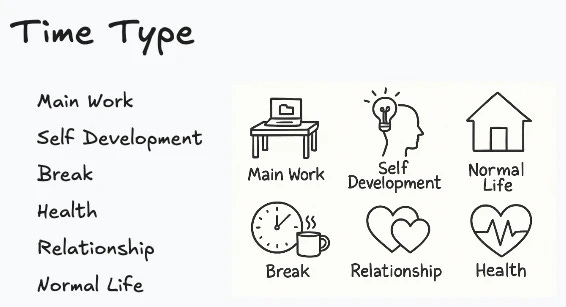
The most common problem in classification is that if there is a time period that I think belongs to two different categories at the same time, how should I distinguish it? After my practice, I have the following solutions:
- Classify according to the main purpose of this time period. For example, when playing games with friends, should it be counted as playing games or maintaining a friendship? It depends on what the main purpose of doing this is. If it is to relax and have a rest, then it should be a type of rest. If it is to get together with friends, then it should be a relationship.
- Record separately according to the original time. For example, how should I record watching a TV series while eating? Meal time is an essential time every day, so there is an original normal meal time, and the part beyond this normal time is regarded as your additional purpose time. For example, the whole process of eating takes 2 hours, then the normal eating time is one hour of daily life, and the remaining hour is the rest time for watching TV series.
- Situations that can be recorded simultaneously. For example, how should you record your work while doing your own thing? The working hours of our job can already bring us value, so the extra time used is counted as the corresponding category record. In other words, we may have more than 24 hours in a day.
Energy Management
The previous content only obtained the optimal task mix for the day. How to do the most appropriate tasks at the most appropriate time is the next goal. By recording time over a period of time, we can know at which time periods every day we do the work we think is important. These time periods are the high-energy time periods every day.
Divide the day into a small time period every 5 minutes, then there will be 288 five minutes in the whole day, which is a vector V with a length of 288. For each day, we can get such a vector. If it is a high-energy time period, it will get 1 in the corresponding time period, and the low-energy time period will get 0.
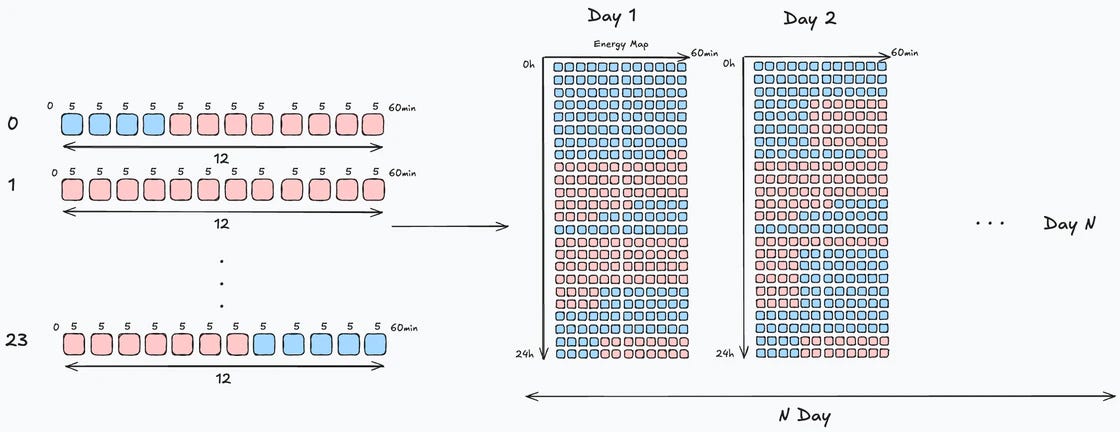

By combining the vectors of all days, an average energy vector V bar can be obtained.

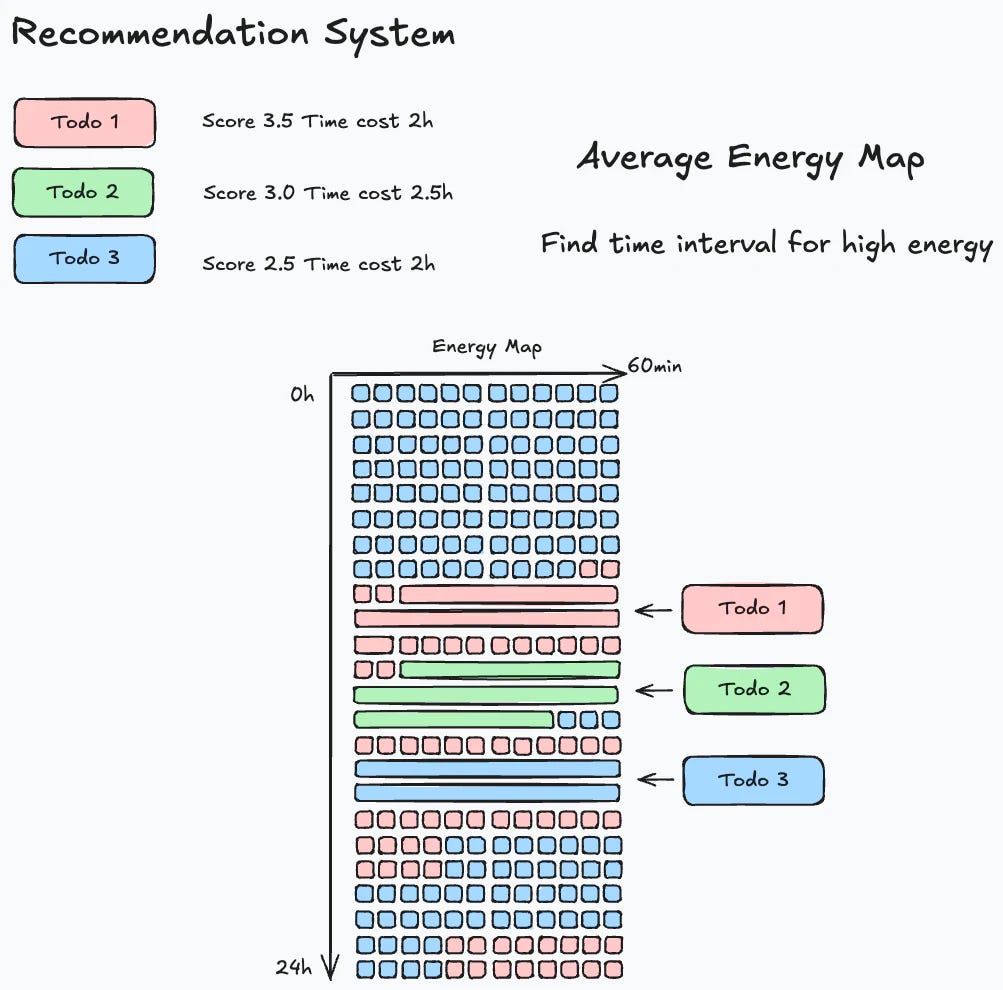
With this average energy vector, the system can know when it is in a high-energy time period and when it is in a low-energy time period. After the recommendation system recommends a reasonable task, it can allocate the task to the time period with the highest energy.
Trinity
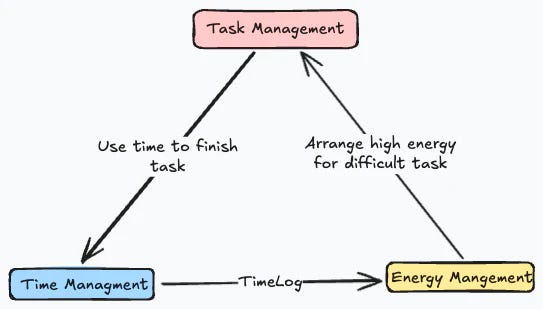
So far, how the time to-do energy in this system is managed has been fully explained. They are the existence of a trinity. After a new to-do is generated, it takes time to complete it, and time can reflect the level of energy to help arrange the to-do better next time. This system hopes to continue to progress and complete the to-dos in this virtuous cycle until the goal is achieved.
FluxTime
The entire system mentioned above seems very complicated and requires a lot of calculations. It is almost impossible for an individual to implement it. In order to allow more people to use this system, I developed a software FluxTime, which allows you to only focus on time recording and creating to-dos. Other task recommendations, energy curve calculations, and result feedback are all left to the software.
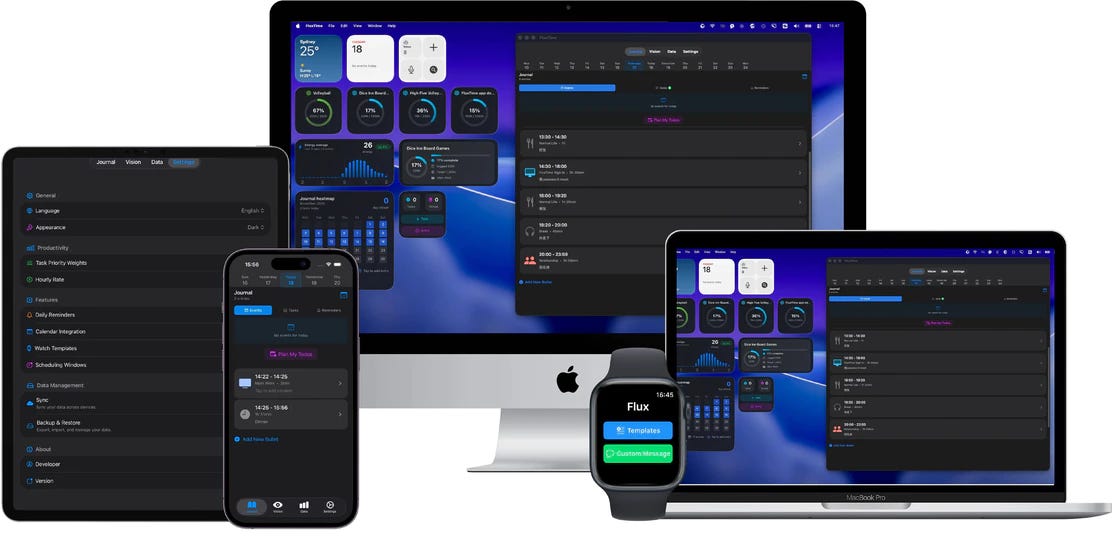
FluxTime is currently on the App Store and is completely free. Readers are welcome to download and test it.