When playing games, you never doubt whether you are making progress. The experience bar is there, the percentage is clear, and there are sound effects and special effects to remind you when you upgrade. You always know what level you are at, and you also roughly know how far you are from the next level.
But there is no such experience bar for skill growth in the real world. This brings two consequences that almost everyone who does one thing for a long time will encounter.
The first one is misjudgment of ability. Because no one has calculated for you how much time you have invested and which stage you are at, it is easy for people to have the illusion that "I am already very good" when they have just passed the novice stage - because there are many novices around to compare with; it is also easy to fall into despair after entering the intermediate stage - because at this stage, you are surrounded by people of similar level, and no matter how you practice, you feel like you are standing still. Arrogance and despair are actually two manifestations of the same problem: not knowing where you are, and you can only guess by comparing yourself with those around you.
The second one is Fear of the Unknown. Even if you know that "ability growth is probably a curve that starts fast and then slows down, with a plateau in the middle," as long as you don't know how many hours you have invested, this curve is still just an abstract truth for you and cannot fall on you - you still don't know where you are on the curve now, and how long you have to go before you see the next qualitative change.
In terms of volleyball, starting from the end of 2022, I spent four years doing a very stupid thing: recording every training time. In the end, it has accumulated more than 1,000 hours. This is not to check in for self-discipline, but to create an experience bar for myself that does not exist in reality. What I want to share in this article is what this experience bar looks like, and how it helps me see clearly where I am at the stage when I am most likely to give up and have self-doubt.
Ability curve
The ability curve is definitely not a linear curve. It does not mean that you can achieve the same progress every 10 times of practice, but a curve that conforms to a power law - the further you go, the more time you need to invest to achieve the same progress, the time you need to invest will increase exponentially, not simply doubling as mildly as possible. A common simplified model is Ability ≈ √Practice Time (the specific index varies from person to person and from project to project. This is just to illustrate the general direction of "marginal diminishing" and is not a formula that is accurate enough to be directly applied).
This results in the feedback you get at different stages being different: with the same investment, the feedback you get is higher in the novice stage, and the feedback is lower the further you go. This is a curve that exists for almost all skills. There may be differences in coefficients, but they generally follow this rule. The same is true for most of the games we play - it definitely takes less energy to upgrade from level 1 to level 10 than from level 10 to level 20, and the higher the level, the more so.
Ability = √Practice time
Confidence Curve
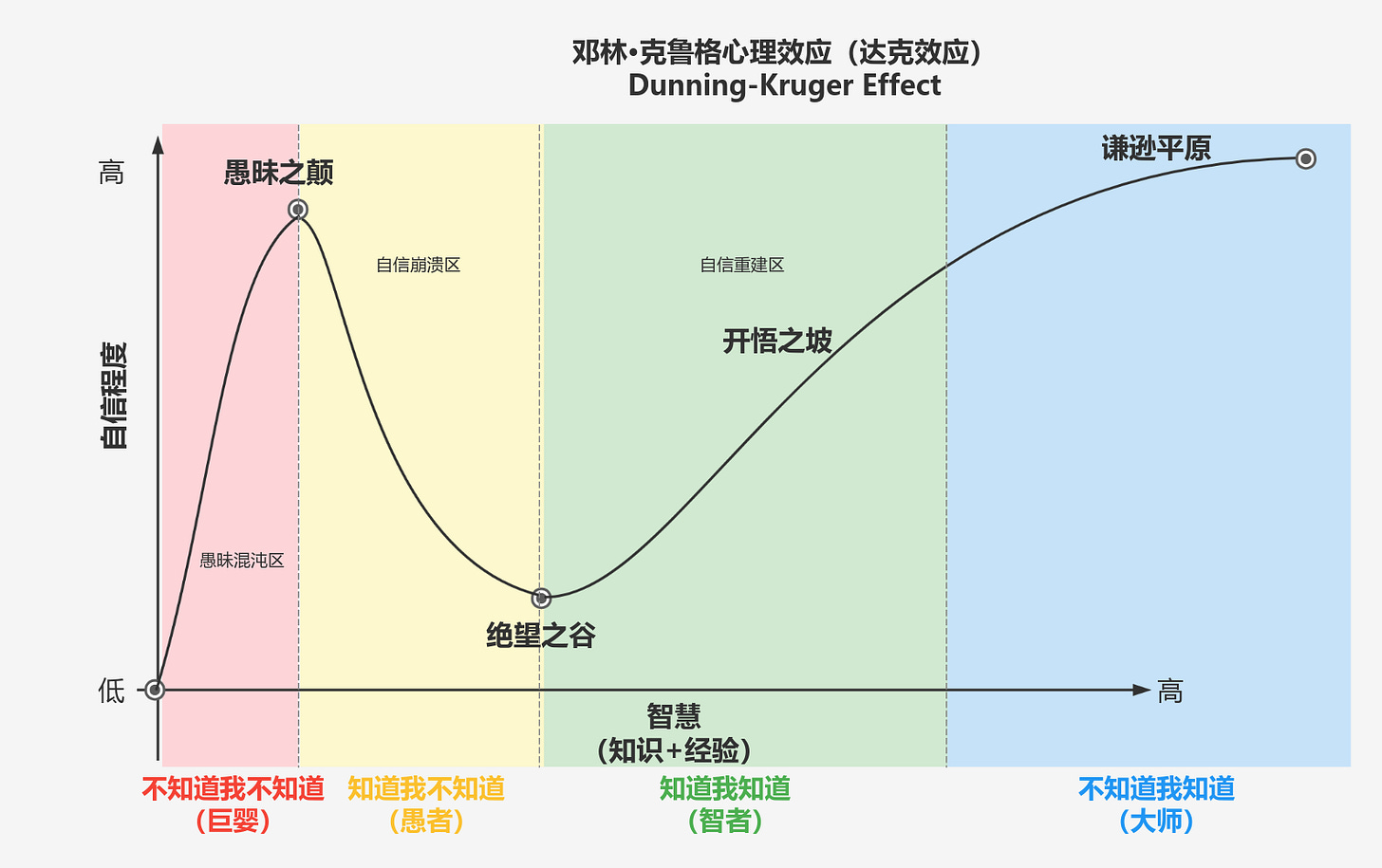
Since there is no experience bar in the game in the real world, we can only evaluate our abilities by comparing ourselves with others, and this comparison process is naturally prone to misjudgment. A picture widely circulated on the Internet - "The Peak of Ignorance - the Valley of Despair - the Slope of Enlightenment - the Plain of Humility" - describes exactly this trajectory of misjudgment.
Let me make one thing clear first: this picture is not the original research conclusion of the "Dunning-Kruger Effect" in psychology. The real Dunning-Kruger effect (proposed by Dunning and Kruger in 1999) compares the self-evaluation deviations of people at different actual levels at the same time - the conclusion is that "people at the bottom seriously overestimate themselves, while people at the top slightly underestimate themselves." It is a one-time cross-sectional comparison, not a journey curve over time. The widely circulated "Peak of Ignorance" picture was a secondary creation later on the Internet. Let's call it the "Confidence Curve."
This curve is easier to understand: after people master some abilities at the beginning, they suddenly feel that they have surpassed many people. The "many people" here actually refer to all human beings, not people within this ability field. At this time, they will mistakenly think that they are on the "peak of ignorance." As I got in-depth contact with real people in this field, I discovered that I was just a novice, my self-confidence collapsed, and I entered the "valley of despair". Most people will choose to give up if they cannot accept this reality, but those who persist, as time accumulates, slowly find that they are surpassing those who gave up or those who were once stronger than themselves, and re-establish their confidence. This is the "slope of enlightenment." When in the end most of the people around you are inferior to yourself, and it is no longer meaningful to compare with others, and all that is left is to constantly break through yourself, you will enter the "Plain of Humility."
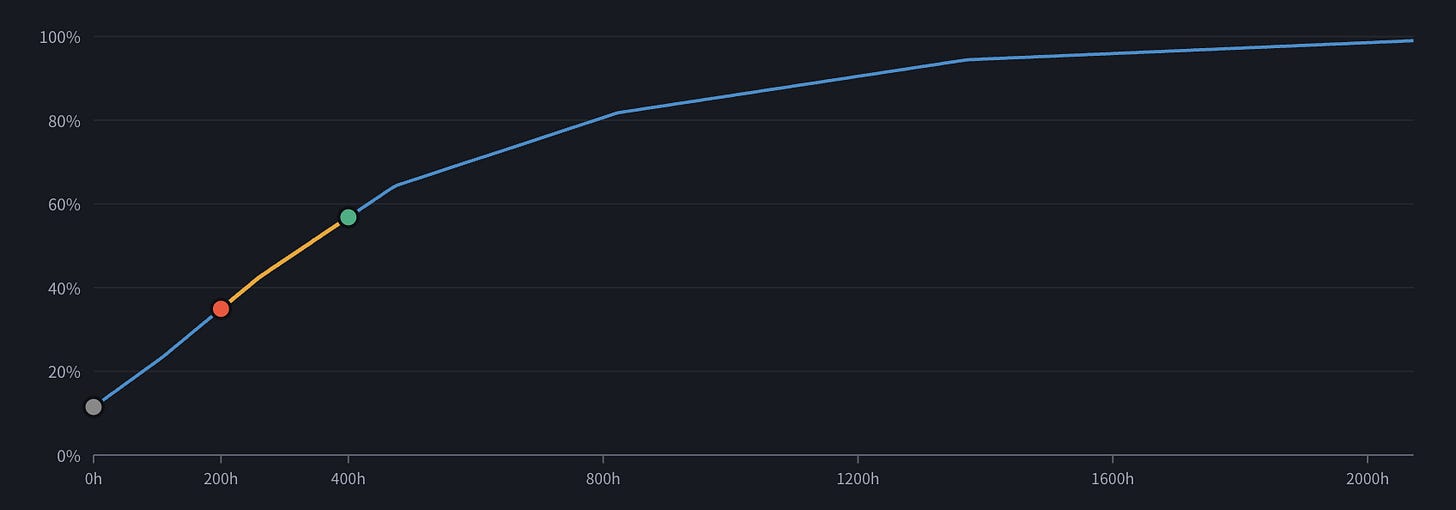
Looking back on my own volleyball career, I have roughly gone through these four stages: 0-100 hours is the entry stage, 100-600 hours is the despair stage, 600-1000 hours is the growth stage, and 1000-2000 hours enters the plain of humility. It should be noted that these specific hours boundaries are purely my personal estimates and feelings, not the results of measurements.
Entry Stage
In the entry stage, we mainly feel how much we love this ability. An observational study of 520,000 fitness app users found that the median time to give up was 14 weeks after starting training, and only 18.1% of beginners were still persisting by the 6th month. Converted into hours (estimated based on 2.5 hours per week for beginners), the median abandonment point is about 35 hours, and most abandonment occurs in the range of 30-70 hours - that is, in the first two or three months. This group of people have already left the market before they have truly experienced the transformation from "unable to able".
But it’s not a bad idea to give up at this stage. If it's not a necessary skill, and if you really don't love it enough, ending it early is a good choice. At this stage, you are probably in the bottom 5% of the field.
Despair stage
This stage will last about 500 hours and is also the most difficult stage. First of all, because of the existence of the ability curve, the feedback is reduced, there is no longer the freshness of 0-100 hours, and the progress is slower. The second is the impact on confidence - after you really enter this field, most people will be stronger than you. You may encounter cynicism, or you may feel that your progress is too slow. At the same time, you will be afraid of the future, and you don't know when you will get out of this stage.
Many people give up at this stage, but it’s not that they don’t have willpower, it’s that they don’t know where they are, and they are better than they are. Also in the game, if you are level 30, would you be sad to see a group of people who are level 90? Most likely not, because you know you can achieve it as long as you work hard. But the reality is that you don't even know what level you are - you only know "it's been two years since I started doing this", but two years is just a time span, not a time investment. In the same two years, will 10 hours a week and 3 hours a week have the same result? This stage roughly corresponds to the change in this field from 5% to 50%.
Growth stage
After getting through the despair stage, you slowly feel that you are more than half of the people. At least for me, you must be more than half of the people before you can have confidence in yourself again. You begin to build confidence, learn more about this field, and know where you are lacking, and you will do special training to make up for your shortcomings instead of practicing in general. You will find that once these shortcomings are made up, you will "progress rapidly" again - but in fact it is not that you are progressing faster, but that you will feel that there are more and more people around you who are not as good as you, because you may have entered the top 20%, which means that only 2 out of 10 people in this field are better than you; for the circle around you, it may be that only 2 out of 100 people are better than you in this area. This stage roughly corresponds to a change from 50% to 80%.
Humility Plain
At this stage, you no longer bother to compare with others, because most people are not as good as you. You will only compare with yourself. The quality of others can no longer affect your mood. When you meet someone who is stronger than you, you will appreciate learning, and when you encounter someone who is weaker than you, you will teach in good faith. This stage is the change from 80%-99%.
Can this curve be simulated mathematically?
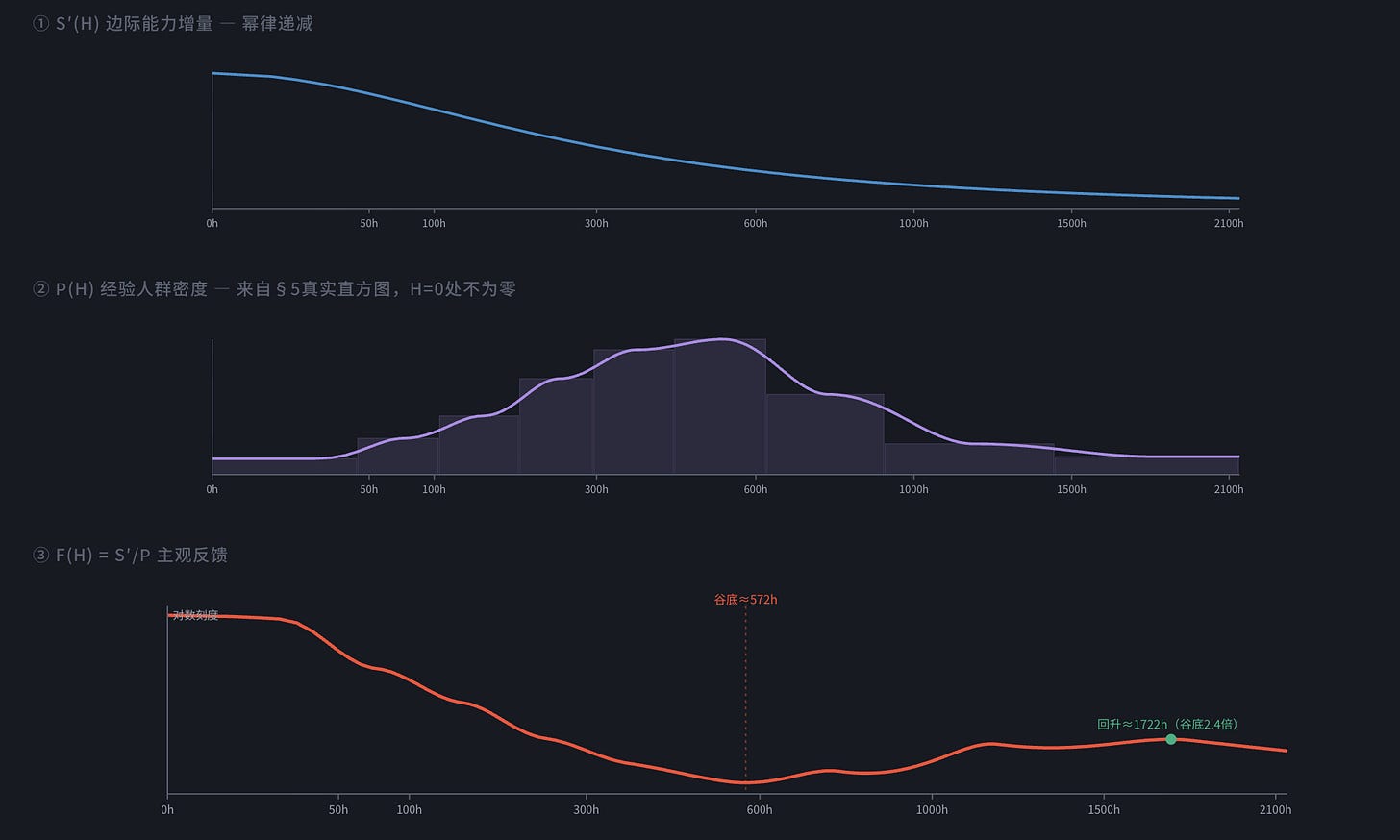
The above is probably my own inference and feeling, but we can actually simulate this curve mathematically, through the data of RunRepeat global marathon research (approximately 19.6 million results, 2008–2018) + Marathon Handbook (more than 3 million results). Here I want to frankly explain the boundaries of reasoning: What the marathon data can prove is that the mathematical structure itself of "S(h)÷P(h) will produce a shape that first falls and then rises" is reasonable - the mechanism behind it (power law decreasing ability growth + strong early freshness, unimodal distribution of crowd density caused by large losses in the mid-term) is most likely a universal human psychological law across fields, and I believe this is generally true in volleyball.
S(H) is the increment of the marginal ability of our ability acquisition, P(H) is the density of the experience crowd, F(H) = S(H)/P(H). The translation of F(H) is how much subjective feedback your progress can bring you compared with the people you have surpassed. We can clearly find that after 600H, our subjective feedback is on the rise.
Understand S(H) as "your absolute progress speed", and P(H) as "how many people are at the same level as you":
- Before the bottom: Your progress is slowing down, and at the same time there are more people of the same level around you - a double blow, the feedback experience plummets
- Near the bottom: This is the moment of "the most serious involution" - you make slow progress, but the competition around you is the most intensive, and no matter how hard you try, it seems mediocre
- After the bottom: Although your progress is still slowing down, the number of people at the same level around you begins to decrease rapidly - at this time, even if the absolute amount of your own progress has not increased significantly, your scarcity relative to your peers is rising rapidly, and the feeling of "I seem to be better than most people" begins to become clear and discernible
How to persist?
So after we know this curve, can we make some adjustments to help ourselves better learn an ability and improve our mentality.
Compare with yourself
The fundamental reason why our mentality fluctuates along with this curve is that we are always comparing ourselves with others - if we compare well, we will be jealous, if we compare poorly, we will feel inferior. That being the case, why not jump right into the “Plains of Humility” mentality from the get-go? Always compare only with yourself: Am I better today than yesterday? Which aspects of myself need improvement? As long as you can feel that you are making progress, you will reach a higher level sooner or later.
Double your investment
This is a rule of thumb that I have figured out myself. It is not strictly derived from the S(h) formula (the learning curve in reality cannot be accurately quantified, and it is not necessary): after the entry period (0-100h), if you are still willing to persist, the best way is to double your investment. To give a rough example: invest 100 hours in the first year, try to invest 200 hours in the second year, and 400 hours in the third year - doubling the investment will not only obtain the feedback intensity closer to the "entry period", but also pass through the valley of despair faster.
Face the reality
In the past four years, most of the people who started playing with me have given up. Even those who persisted, most of them stayed in the despair stage. The lower the feedback, the lower the frequency of playing. The vicious cycle makes it more difficult for people to get through this stage. In order to get higher feedback, some people will participate in a game where their level is obviously lower than theirs. In that game, they are the best and others are not as good as them. This can bring more positive feedback. I call this state "super novice". While thinking that I have been playing for five years, I may actually only play once a week, but in the end I am still stuck in the stage of despair.
I did a statistics at the end of 2024 and found that in the two years from 2022 to 2024, I only spent about 350 hours on volleyball-basically playing once a week. I suddenly woke up: I had been thinking about how I had not made any progress after playing for two years, but the reality is that I only invested 350 hours. When I used to play games like crazy, I could play nearly 200 hours in two weeks.
So I set a goal for myself in 2025: to achieve 300 hours alone this year, and I really did it this year. This decision brought me quickly through the stage of despair. After entering 2026, I continued this investment rhythm, and now the cumulative total in four years has finally exceeded 1,000 hours (350 hours + 300 hours + investment since 2026). This year I really feel that I have made great progress again and the feedback is very high - according to the previous model, this is probably around the turning point from the end of the despair stage to the growth stage.
- The false reality is: "I've been playing for two years, but why am I still so bad?"
- The real reality is: "I only spent 350 hours in two years, so there shouldn't be much progress."
Pain is a signal of progress
There must be pain in the process of improving ability, whether it is psychological or physical. After all, you need to jump out of your comfort zone and show your shortcomings. The way each person faces pain determines the speed of progress. If you only feel sorry for yourself in the face of pain instead of solving it, you will end up staying where you are.
But the emergence of pain often indicates that you have reached the boundary of your abilities, which is actually a signal of progress. Let’s take the simplest example: when you lift iron in the gym, your muscles can withstand 5kg. If you practice 1kg every day, you will not make any progress no matter how long you practice; but as long as you try 6kg, it will cause muscle soreness - this pain is evidence that the body is making progress. The aforementioned "I like to play games that are not as good as my own level" is, to a certain extent, doing 1kg training: people will not blame you for your mistakes, but will praise you. But if you go to a higher-level game, you may be the weakest one on the field. Others may blame you, or they may teach you - as long as you can screen rationally and absorb it correctly, both types of feedback can bring about progress. Of course, accusations will cause psychological discomfort, but you need to put your emotions aside and rationally judge whether the accusation is right or wrong: accept it if it is right, and ignore it if it is wrong.
Epilogue
These four years and 1,000 hours have witnessed my growth in volleyball, but this is not an end, but the beginning of more 1,000 hours. The statistics in 2024 also confirmed the need to record time. Everyone is willing to record their money, but not so many people record their precious time. FluxTime is the software I created after that. It is a clumsy but real experience bar for me. I can clearly know where I am towards my goal. It does not mean that I will succeed if I have enough time, but it can make me calm down and make little progress.